
TEAM — A Purpose-Built AI-Powered EdTech Ecosystem for Future-Ready Schools
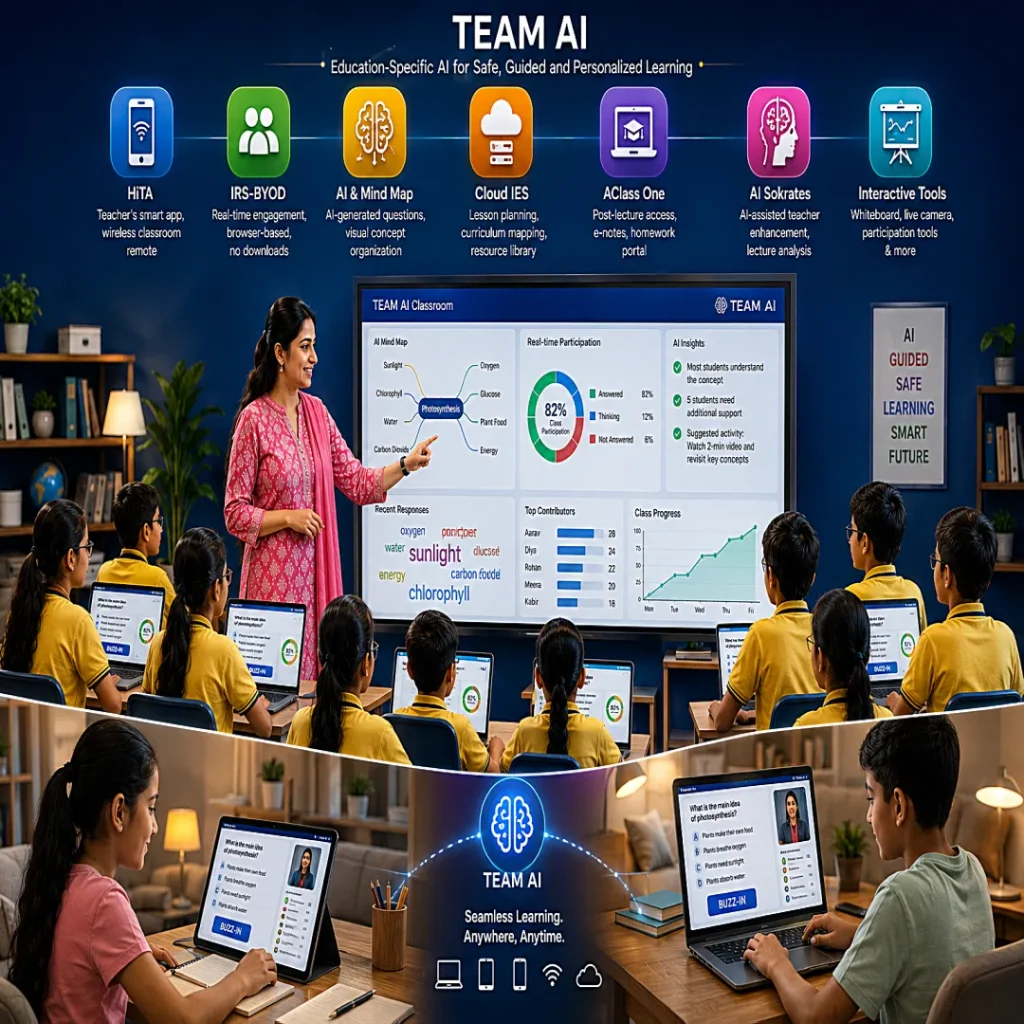
Teachers Teach with Confidence. Students Learn with Enthusiasm. Institutions Transform with AI.
Driven by the global AI wave, school education is standing at a critical turning point. Faced with the immense power of Generative AI, educational leaders and teachers often find themselves balancing the expectation of enhanced learning efficiency with concerns about safe and appropriate classroom adoption.
Selecting an AI tool that aligns with future trends while ensuring stable implementation has become the primary task for school AI-based transformation.
Many schools fall into the Switching Trap, moving from one app to another, which creates cognitive fatigue for teachers. We advocate for an Endogenous System where technology is deeply integrated into the essence of teaching. By choosing a stable ecosystem like TEAM along with Sokrates, schools ensure the continuity of data and the steady growth of your faculty.
TEAM AI is an Education-Specific AI solution designed exclusively for educational environments. Guided by teachers and aligned to classroom learning objectives, it enables schools to introduce AI safely into everyday teaching and learning while maintaining the essential role of teacher-student interaction.
The TEAM AI Ecosystem: One Unified Platform for Smarter Classrooms
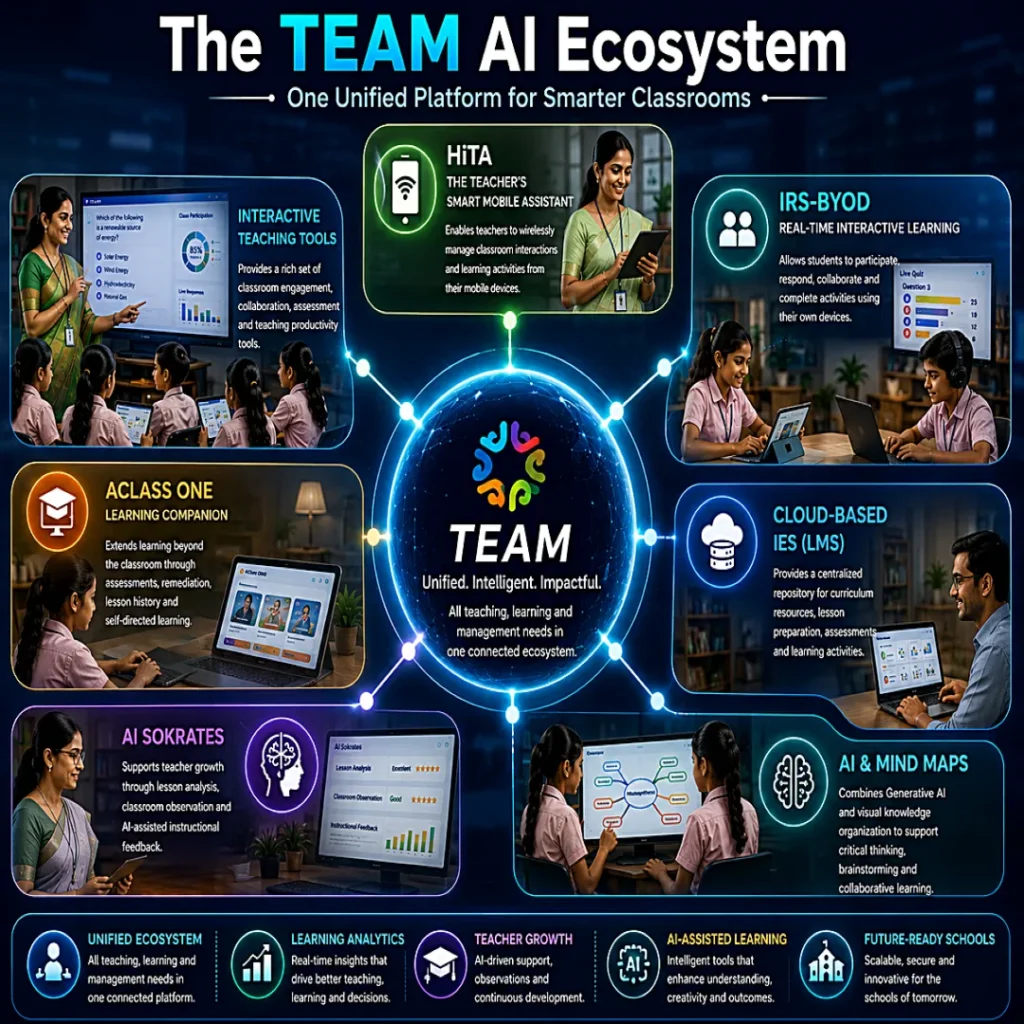
Many schools manage separate systems for lesson delivery, classroom interaction, assessment, learning resources, student follow-up, and teacher development. As schools adopt more digital tools and AI applications, the challenge is no longer access to technology, but managing multiple disconnected platforms efficiently.
TEAM addresses this challenge through a unified ecosystem of interlinked modules designed to support classroom teaching, assessment, collaboration, self-directed learning, and professional teacher growth within a single platform.
The TEAM AI ecosystem combines seven integrated components that work together to support both classroom and post-class learning experiences.
🎯HiTA – The Teacher’s Smart Mobile Assistant:
Enables teachers to wirelessly manage classroom interactions and learning activities from their mobile devices.
🎯IRS-BYOD – Real-Time Interactive Learning:
Allows students to participate, respond, collaborate, and complete learning activities using their own devices.
🎯Interactive Teaching Tools:
Provides a rich set of classroom engagement, collaboration, assessment, and teaching productivity tools.
🎯Cloud-Based IES:
Provides a centralized repository for curriculum resources, lesson preparation, assessments, and learning activities.
🎯AClass One Learning Companion:
Extends learning beyond the classroom through assessments, remediation, lesson history, and self-directed learning.
🎯AI & Mind Maps:
Combines Generative AI and visual knowledge organization to support critical thinking, brainstorming, and classroom discussions.
🎯AI Sokrates:
Supports teacher growth through lesson analysis, classroom observation, and AI-assisted instructional feedback.
Safety First: Education-Specific AI
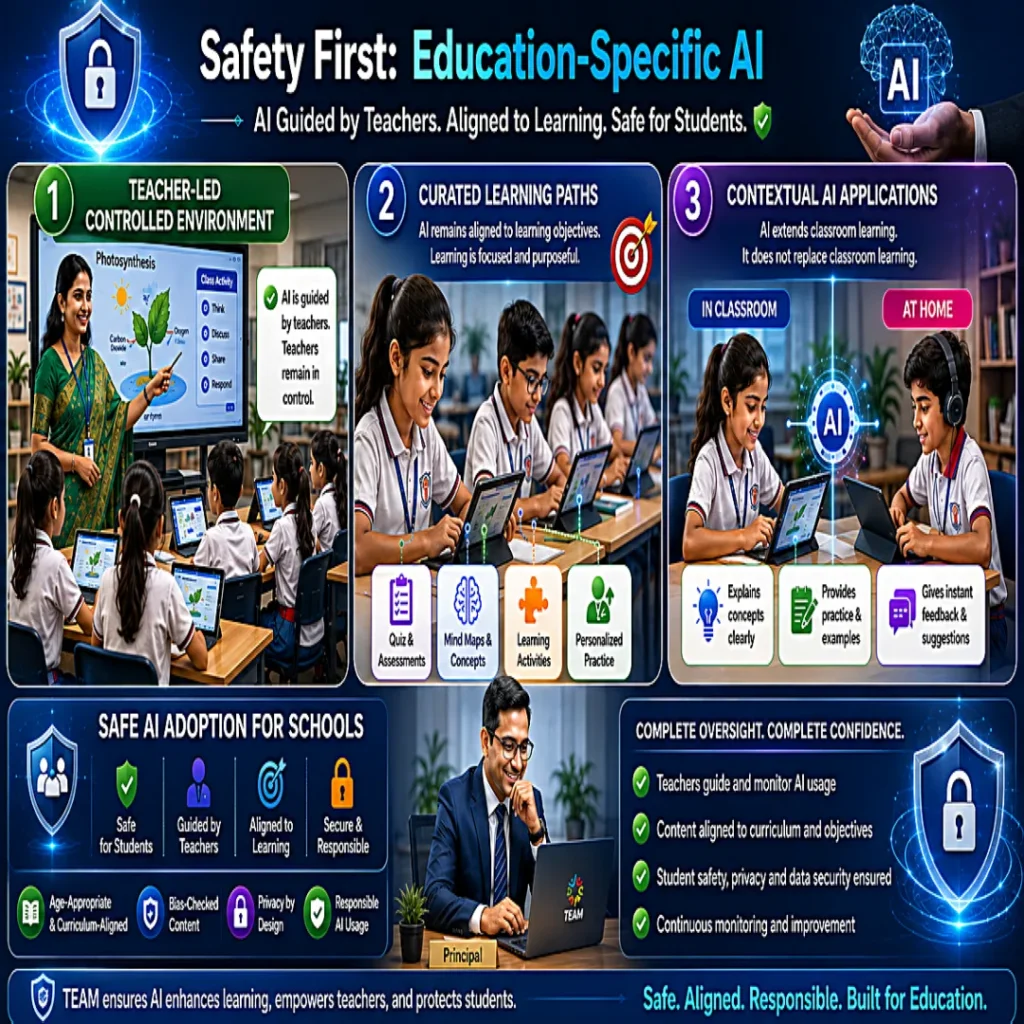
Educational institutions require AI solutions that align with classroom objectives while ensuring safe and responsible usage. Unlike general-purpose AI tools, TEAM AI is an Education-Specific AI solution designed exclusively for educational environments. Rather than exposing students to an unrestricted ocean of information, TEAM AI operates within the context of classroom learning and teacher guidance.
🚀Teacher-Led Controlled Environment:
All AI applications are activated under teacher guidance. This approach provides a structured learning environment where AI supports teaching and learning while teachers remain in control of classroom instruction.
🚀Curated Learning Paths:
Students access AI-generated content that is aligned to classroom learning objectives and curriculum context. By keeping AI interactions connected to classroom instruction, learning remains focused, relevant, and purposeful.
🚀Contextual AI Applications:
TEAM AI extends classroom learning rather than replacing it. Students use AI within the context of classroom discussions, learning activities, assessments, and guided inquiry, ensuring that AI serves as a learning companion rather than a source of distraction.
TEAM – Safe AI Adoption for Schools
Classroom Practice: From Information Delivery to Deep Dialogue and Critical Thinking
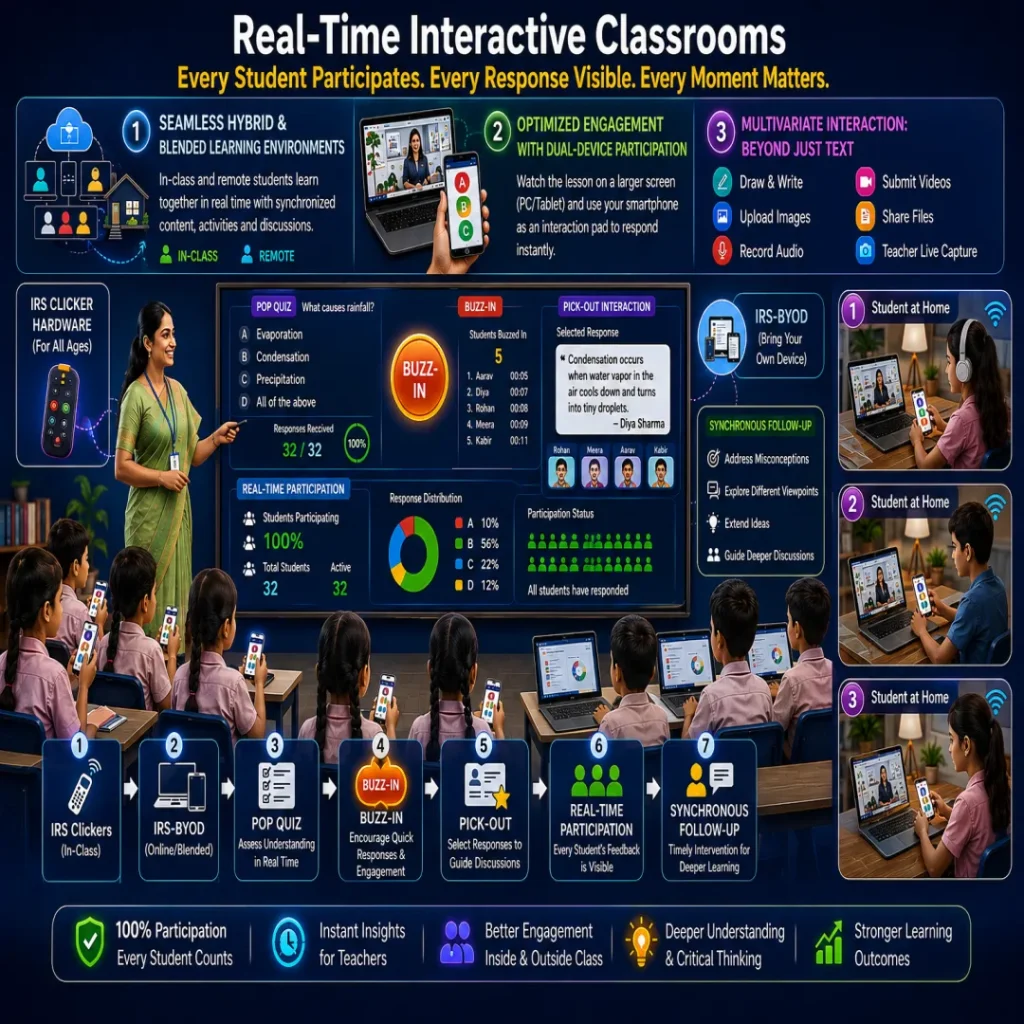
Traditional classroom teaching often focuses on delivering information to students. TEAM AI transforms this process by helping teachers move beyond information transmission toward active participation, collective intelligence, classroom dialogue, and critical thinking. By combining real-time interaction, AI-assisted analysis, and guided discussions, TEAM AI helps create more engaging and meaningful learning experiences.
Real-Time Interactive Classrooms
🎯Seamless Hybrid and Blended Learning Environments
Schools need flexibility to support students whether they are sitting in the classroom or learning from home. TEAM is uniquely designed to support unified hybrid classrooms where physical and remote learners participate simultaneously. Whether a student is in the classroom or online, they receive the same synchronized whiteboard pages, participate in the same live IRS Pop Quizzes, and collaborate on the same digital Mind Maps in real time. This ensures that remote learners are never just “watching” a class, but are actively participating alongside their in-class peers.
🎯IRS-BYOD (Bring Your Own Device):
IRS-BYOD allows students to participate using any connected device, including tablets and laptops, through a browser-based environment requiring no application download or installation.
By leveraging existing student devices, schools can scale interactive learning efficiently while ensuring seamless participation both inside and outside the classroom.
For students participating in online or blended sessions, screen real estate is critical. TEAM supports a highly effective dual-device participation mode. Remote students can attend the live video lesson or view the teacher’s desktop share on a larger screen (like a laptop or tablet) while simultaneously using their smartphone as a dedicated interaction pad. This allows them to instantly answer quizzes, participate in Buzz-in activities, and submit tasks without constantly switching windows or interrupting their view of the lesson.
For junior classes, TEAM supports dedicated IRS Clicker devices designed for simple and intuitive classroom participation. Young learners can respond instantly without requiring personal devices or advanced technical skills.
This provides schools with a practical and cost-effective pathway to introduce interactive learning across all grade levels.
IRS Pop Quiz enables teachers to assess understanding at any point during a lesson. Student responses are collected instantly, allowing teachers to gauge comprehension before moving forward.
Rather than waiting until the end of a lesson or examination, teachers can identify misconceptions immediately and provide timely intervention. This helps maintain learning continuity and supports informed instructional decisions.
Buzz-In transforms passive classroom questioning into an active learning experience. Instead of waiting for a few students to respond, students compete to contribute answers, ideas, and viewpoints in real time.
By encouraging rapid participation, Buzz-In increases attentiveness, promotes healthy classroom competition, and motivates students to think independently before responding. Teachers can quickly identify varying levels of understanding and use student responses as starting points for deeper classroom discussions.
Classrooms often generate a large number of student responses, making it difficult for teachers to identify representative viewpoints. Pick-Out enables teachers to instantly select and display specific student responses for further discussion.
By examining different perspectives, students learn to compare ideas, justify reasoning, and critically evaluate alternative viewpoints. This creates opportunities for richer classroom dialogue and collaborative knowledge construction.
In many classrooms, participation is often limited to a small number of students. TEAM enables every student to participate and contribute simultaneously, ensuring that classroom interaction reflects the thinking of the entire class rather than a select few.
By ensuring that every student’s feedback is visible, teachers gain a comprehensive view of classroom understanding, participation levels, and emerging learning needs.
Beyond Just Text True classroom dialogue requires multiple forms of expression. The TEAM ecosystem breaks the limitations of standard text-based interaction by supporting Multivariate Subjective Tasks.
- Visual & Written: Students do not just type; they can draw directly on their screens, take pictures of handwritten math calculations or worksheets, and send them instantly to the teacher’s board.
- Audio & Voice: For language and speaking exercises, students can record real-time audio responses directly on their devices, which can even be automatically graded by the AI Speech Recognition engine.
- Video & Multimedia: Students can submit multimedia files, including PowerPoint, Excel, or short videos, making it perfect for project-based learning.
- Teacher Agility: Simultaneously, the teacher can use the HiTA mobile app to snap photos or record video of physical classroom activities and instantly broadcast them to both physical and online students.
Meaningful learning occurs when teachers can act on student thinking at the moment it emerges. Synchronous Follow-Up enables teachers to immediately address misconceptions, explore representative viewpoints, extend promising ideas, and guide classroom discussions.
By enabling timely intervention and instructional guidance, teachers can continuously monitor learning progress and keep students actively engaged throughout the lesson.
Smart Summarization and Guided Critical Thinking
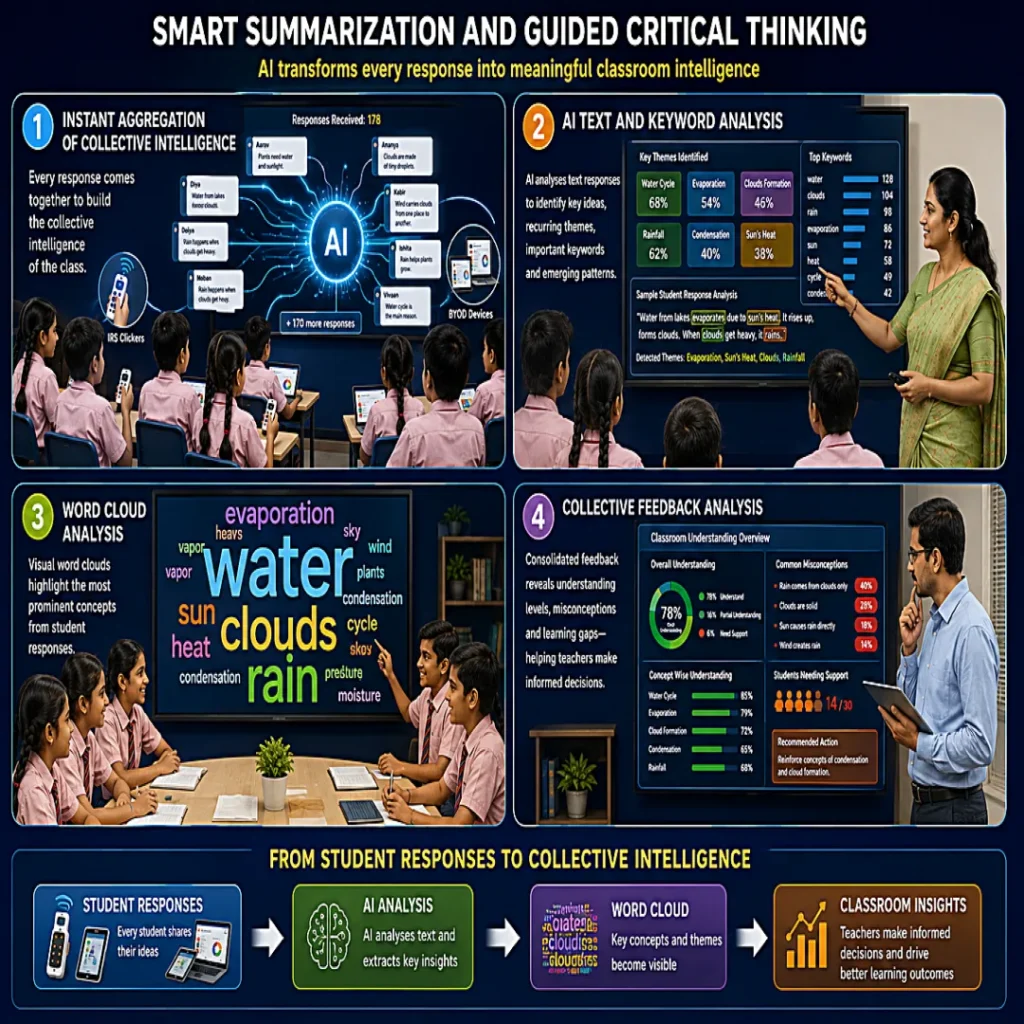
When every student participates, classrooms generate a rich collection of ideas, opinions, questions, and responses. TEAM AI helps teachers transform this collective intelligence into meaningful learning opportunities by organizing, analysing, and presenting student thinking in forms that support deeper classroom discussions and critical thinking.
Instant Aggregation of Collective Intelligence:
Classroom responses often contain valuable insights that may otherwise remain hidden within hundreds of individual submissions. TEAM AI instantly aggregates student responses, enabling teachers to view the collective thinking of the entire class and identify emerging patterns, ideas, and viewpoints.
AI Text and Keyword Analysis:
Open-ended student responses provide valuable evidence of understanding, reasoning, and misconceptions. TEAM AI automatically analyses student responses to identify key ideas, recurring themes, important keywords, and emerging patterns across the classroom.
By transforming large volumes of text into meaningful classroom insights, teachers can quickly identify areas of understanding, uncover misconceptions, and focus classroom discussions on the concepts that matter most.
Word Cloud Analysis:
TEAM AI converts student responses into visual word clouds that highlight dominant themes and concepts emerging from classroom discussions. By making collective thinking visible, teachers can encourage students to explore relationships between ideas and reflect on different perspectives.
Collective Feedback Analysis:
Rather than reviewing responses individually, teachers can view consolidated classroom feedback that reveals patterns of understanding, misconceptions, confidence levels, and learning gaps. This enables teachers to make informed instructional decisions and guide more meaningful classroom interactions.
Mind Maps and Knowledge Structuring
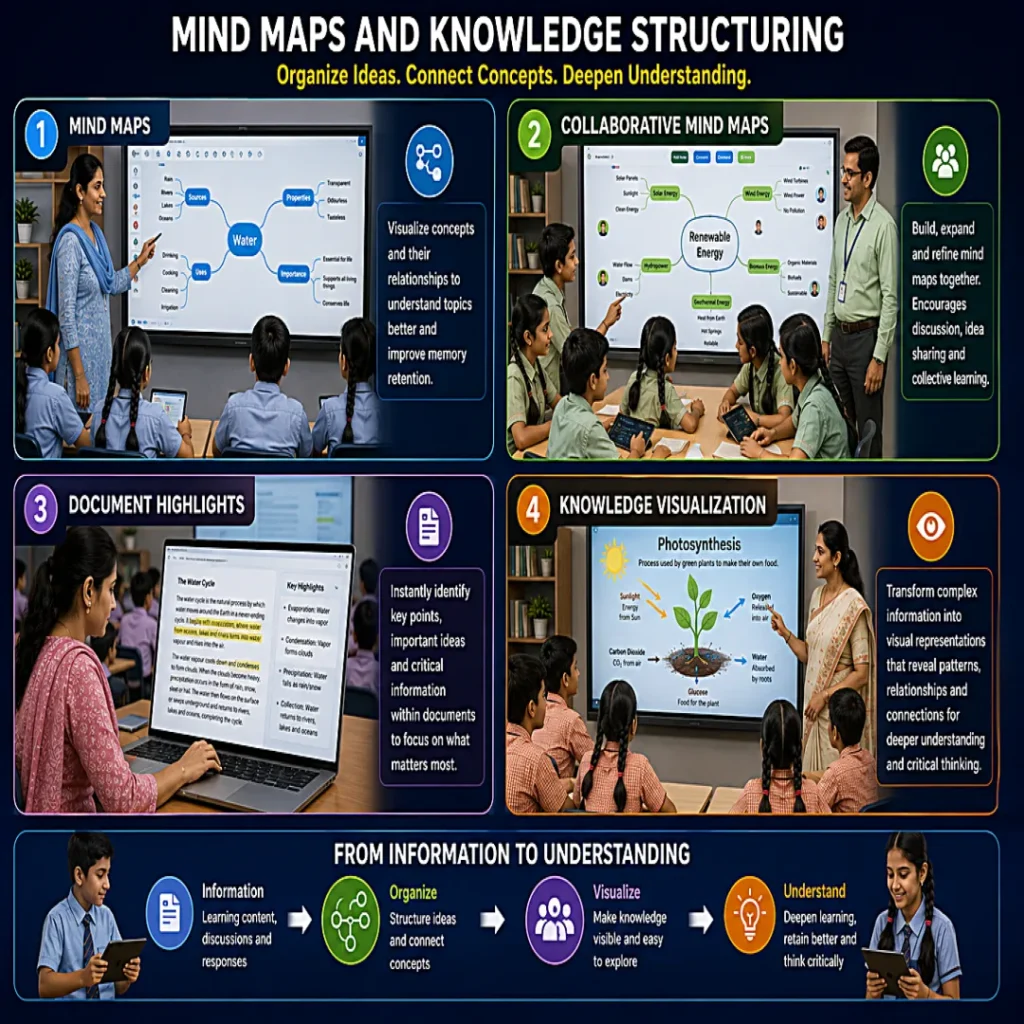
Information becomes meaningful when learners can connect ideas, identify relationships, and organize knowledge into coherent structures. TEAM AI helps teachers and students transform classroom discussions, learning materials, and collective intelligence into visual knowledge frameworks that support deeper understanding and long-term retention.
Collaborative Mind Maps:
Learning becomes more meaningful when students actively contribute to knowledge construction. Collaborative Mind Maps enable teachers and students to build, expand, and refine knowledge structures together, encouraging discussion, idea sharing, and collective exploration of concepts.
Document Highlights:
Important concepts are often buried within large volumes of learning content. TEAM helps teachers and students quickly identify key points, important ideas, and critical concepts within documents, allowing learners to focus on the most relevant information and supporting more efficient knowledge acquisition.
Knowledge Visualization:
Knowledge Visualization transforms complex information into intuitive visual representations that make patterns, relationships, and conceptual connections easier to understand. By making knowledge visible, students can explore ideas more effectively, strengthen critical thinking, and develop deeper conceptual understanding.
From Information to Understanding
By combining AI Mind Maps, Collaborative Mind Maps, Document Highlights, and Knowledge Visualization, TEAM helps students move beyond information consumption toward meaningful understanding, knowledge organization, and deeper learning.
Guiding Deep Dialogue
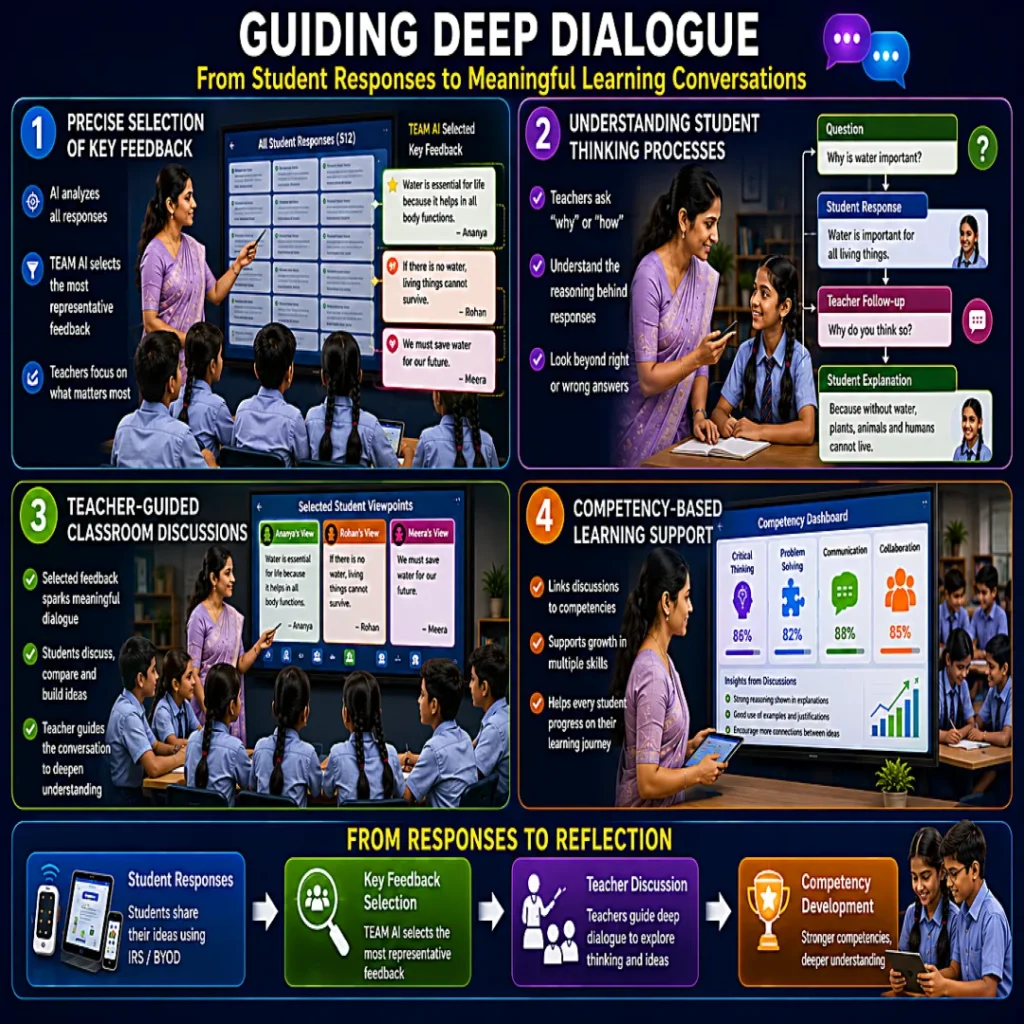
When every student response is collected, summarized, and analysed, the next step is meaningful classroom dialogue. TEAM AI helps teachers move beyond simply reviewing answers by identifying representative feedback, surfacing different viewpoints, and supporting deeper discussion around student thinking.
TEAM AI can accurately select representative feedback from large volumes of student responses. This helps teachers focus on the most relevant ideas, misconceptions, and viewpoints instead of manually scanning every submission.
Through Synchronous Follow-up, teachers can ask students the “why” or “how” behind an answer. This allows teachers to understand the reasoning process behind student responses, not just whether the answer is right or wrong.
Selected feedback becomes the starting point for classroom discussion. Teachers can use representative student responses to clarify concepts, compare viewpoints, and guide students toward deeper understanding through structured dialogue.
By grounding discussions in actual student feedback and thinking patterns, TEAM AI supports competency-based learning. Teachers can connect classroom dialogue to demonstrated understanding, reasoning, and learning needs rather than relying only on final answers.
Real-Time Assessment Revolution
Traditional assessment often separates evaluation from the learning process. TEAM transforms assessment into a continuous, interactive, and classroom-integrated learning experience where participation, feedback, reflection, and evaluation happen in real time.
By combining AI-assisted workflows, automated assessment support, peer review, classroom interaction, and learning diagnosis, TEAM helps teachers reduce assessment complexity while enabling students to learn actively through continuous feedback and participation.
TEAM AI Flow
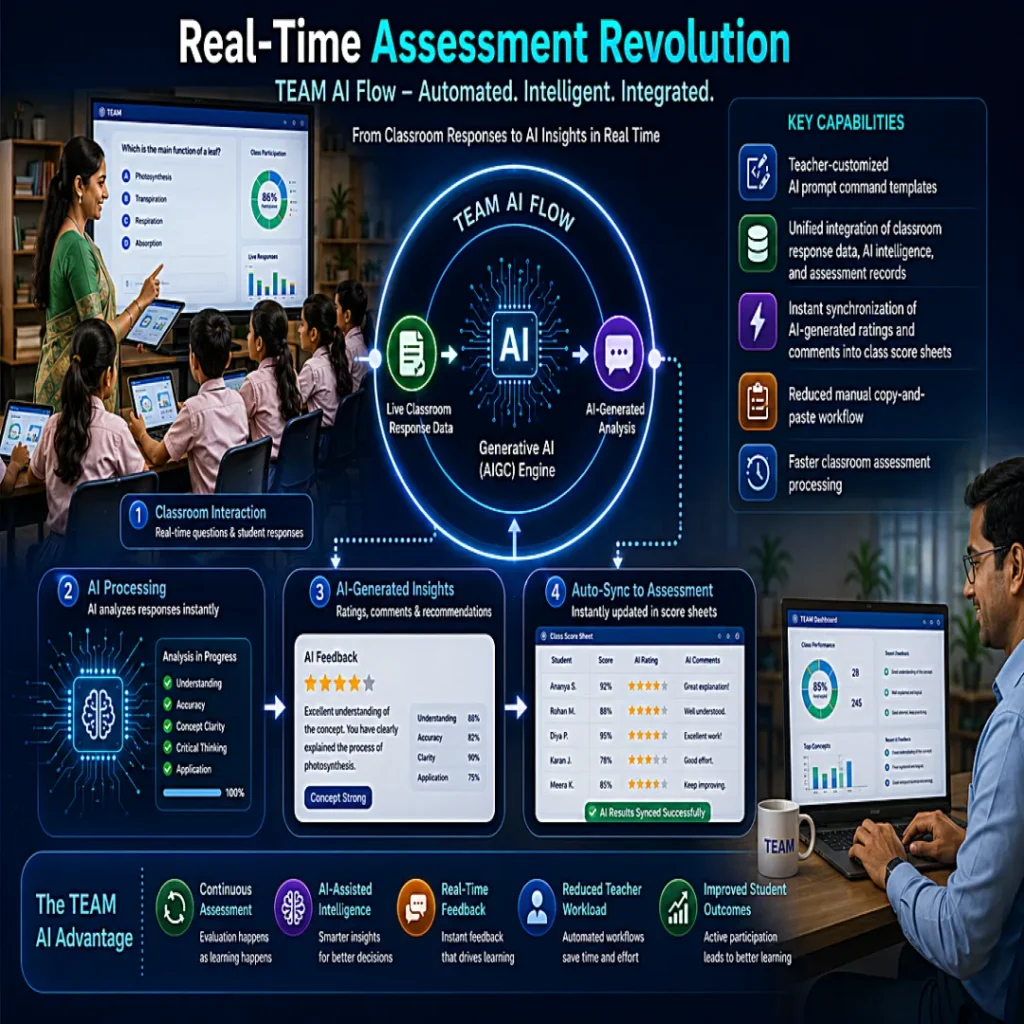
Traditional “self-service AI” workflows often require teachers to repeatedly copy student responses into external AI tools and manually transfer AI-generated scores and comments back into assessment records. As classroom participation increases, this process becomes time-consuming and difficult to manage within real teaching environments.
TEAM AI Flow is an automated integration system that directly connects real-time classroom feedback data (“live” data) with Generative AI (AIGC) services. Using built-in or teacher-customized prompt command templates, the system instantly processes classroom responses and integrates AI-generated outputs directly into the assessment workflow.
By automating repetitive assessment processes, TEAM AI Flow helps schools streamline classroom assessment management while improving feedback continuity and practical classroom usability.
Key Capabilities:
🎯Faster classroom assessment processing
🎯Teacher-customized AI prompt command templates
🎯Unified integration of classroom response data, AI intelligence, and assessment records
🎯Instant synchronization of AI-generated ratings and comments into class score sheets
🎯Reduced manual copy-and-paste workflow
AI Automated Grading
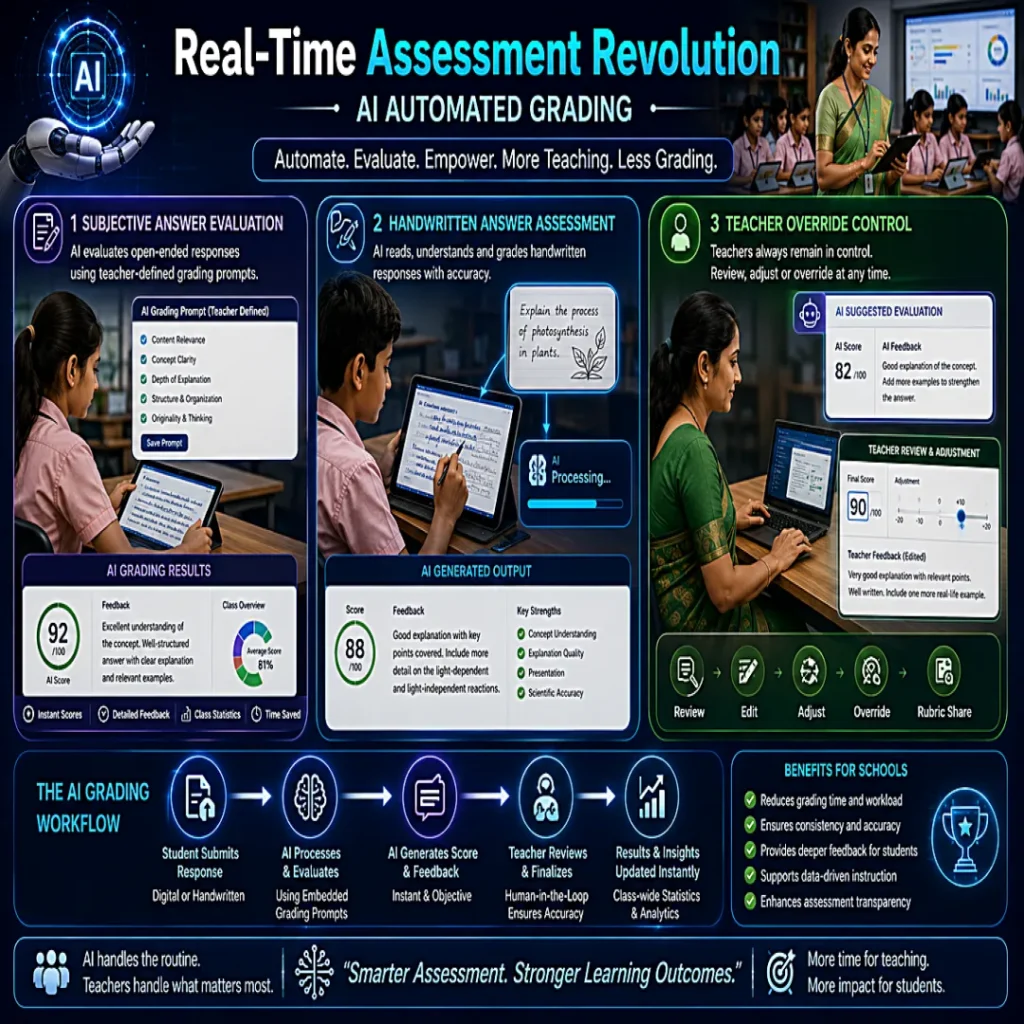
Evaluating large volumes of assignments, quizzes, and subjective responses can become one of the most time-consuming responsibilities for teachers. AI Automated Grading helps reduce this grading burden by automating repetitive assessment processes while enabling teachers to focus more on teaching innovation, classroom interaction, and individualized student guidance.
AI Automated Grading is designed to handle open-ended and subjective questions. During lesson preparation, teachers can embed customized AI grading prompts directly into digital assignments, syllabus materials, or quizzes.
Once students submit their responses, teachers can instantly activate AI grading. The system automatically evaluates subjective answers based on the embedded grading prompts and generates scores, detailed feedback, and class-wide assessment statistics.
AI Automated Grading can also assess handwritten student submissions. When interactive pages contain embedded AI grading prompts, students can write essay answers or problem-solving responses directly on their tablets using handwriting input.
After submission, the AI processes the handwritten visual data and automatically generates scores and personalized feedback for each student response.
AI Automated Grading follows a “Human-in-the-Loop” approach where teachers always remain the final authority in the evaluation process. After the AI generates initial scores and feedback, teachers can manually review, correct, adjust, or override any evaluation at any time.
This ensures that grading remains accurate, fair, and aligned with the teacher’s professional judgment while also supporting collaborative rubric sharing and consistent school-based evaluation practices.
Self Pace Testing Environment
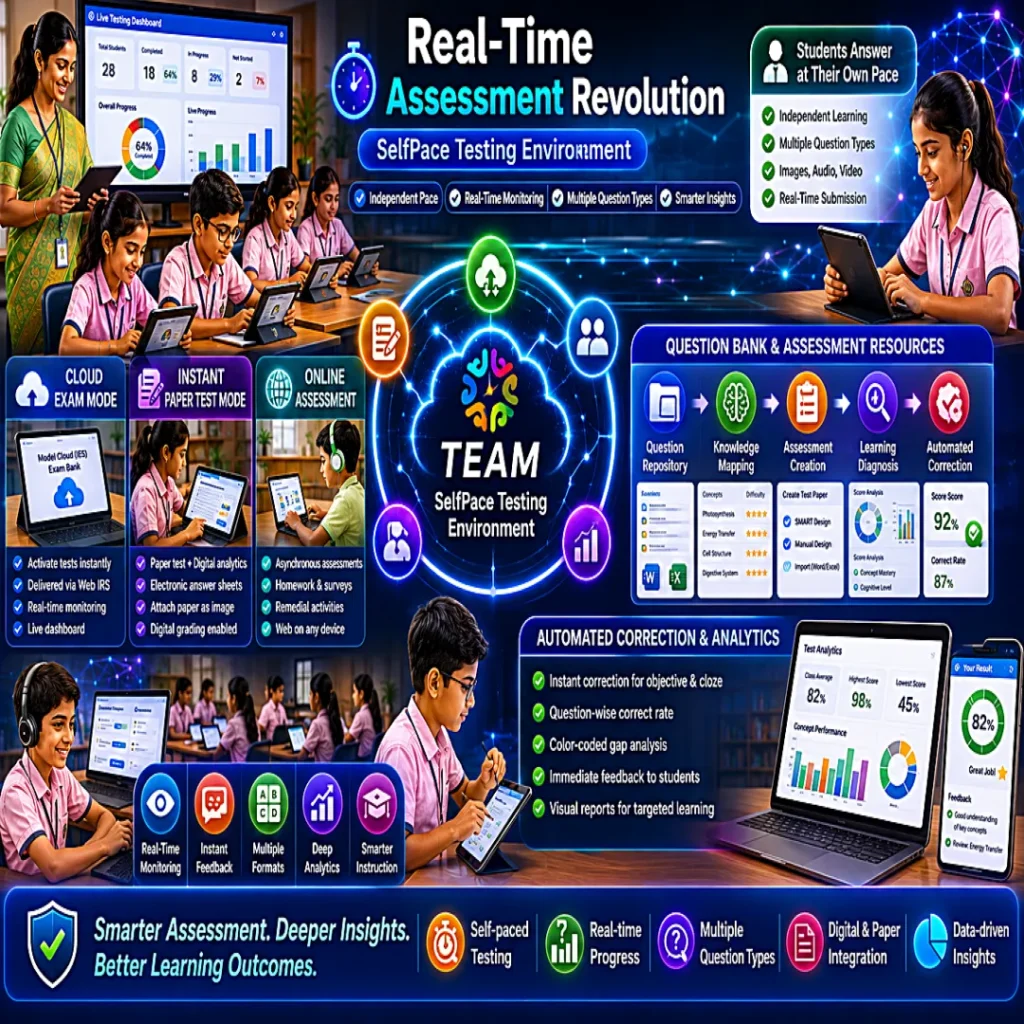
The Self Pace Testing Environment enables teachers to conduct synchronous classroom tests where students answer questions independently at their own pace using their devices. The system supports diverse question types including single answer, multiple answers, true-false, cloze, and question sets with multimedia content such as images, audio, and video.
Teachers can monitor the classroom’s overall testing progress in real time while students complete assessments independently.
- Activate pre-built digital tests directly from the TEAM Model Cloud (IES) exam bank
- Test content is instantly delivered to student devices through Web IRS
- Teachers can monitor live answering progress for every student through a real-time dashboard
- Combines traditional paper tests with digital assessment analytics
- Student devices function as electronic answer sheets
- Teachers can quickly configure answer sheets without preparing full digital tests
- Physical test papers can be attached as reference images for student viewing
- Enables digital grading and response collection while preserving paper-based testing workflows
- Supports asynchronous assessments through AClass ONE Learning Companion
- Students can complete tests, homework, surveys, and remedial activities outside classroom hours
- Accessible from tablets, computers, and smart phones using a web browser
Question Bank and Assessment Resources:
Question Repository The IES Cloud Platform serves as a centralized, systematic repository for building and managing school-wide question banks and teaching resources. Educators can directly edit questions in Microsoft Word or Excel and import them into the cloud platform to build a robust, digital database. This repository accommodates a wide variety of question types, including objective formats (single/multiple choice, true-false) and subjective formats (cloze, writing, matching, and essay). Once imported, these items become an accumulative resource; even if a specific exam file is deleted, the individual questions are retained in the question bank for future use.
Knowledge Point Mapping:
To ensure assessments accurately measure student understanding, the system allows educators to map specific educational parameters to every question in the repository. Each question can be tagged with targeted key concepts (using commas to separate multiple concepts) and assigned a difficulty level ranging from 1 (easy) to 5 (hard). Furthermore, questions can be precisely mapped to specific cognitive levels—such as Remember, Understand, Apply, Analyze, Evaluate, and Create—allowing institutions to track cognitive mastery comprehensively.
Assessment Creation:
The system offers highly flexible and efficient methods for constructing exams and test papers. Teachers can utilize three primary assessment creation modes:
- SMART Test Paper Design: The system automatically generates a customized test paper from the question bank based on the teacher’s selected subject, difficulty level, and desired question types.
- Manual Test Paper Design: Educators can hand-pick specific questions from the repository to build a custom test paper tailored to their immediate needs.
- Import Test Paper Design: Teachers can directly import MS Word or Excel files to instantly create cloud-based test papers.
Once an assessment is created, the system can synchronously auto-generate an integrated answer sheet that accommodates both OMR scanning (for objective questions) and subjective written responses in a single document. This eliminates the need for tedious manual formatting and separate answer sheets.
Learning Diagnosis:
Following an assessment, the system transitions from simple grading to deep analytical insights. The PLAYTOL Learning Assessment Analysis System (LASS) and the clouDAS Diagnostic Analysis Module process the test data to generate over 30 distinct cloud-based diagnostic reports. These multi-dimensional reports include Score Analysis, Placement Analysis, Test Question Analysis, Key Concept Mastery, and Cognitive Level Mastery.
By providing these detailed analytics, the system empowers multiple stakeholders: school leaders can systematically track institutional learning effectiveness, teachers can develop highly targeted remedial strategies, and students are empowered to conduct self-directed study specifically focused on their incorrectly answered questions and personal learning weaknesses.
- Objective and cloze questions are corrected instantly when the test ends
- Individual scores and question-wise correct rates are automatically calculated
- Color-coded analytics help teachers quickly identify learning gaps
- Students receive immediate feedback on their devices
- Interactive charts and visual analytics support targeted review and differentiated instruction
Peer Review and Perspective Learning
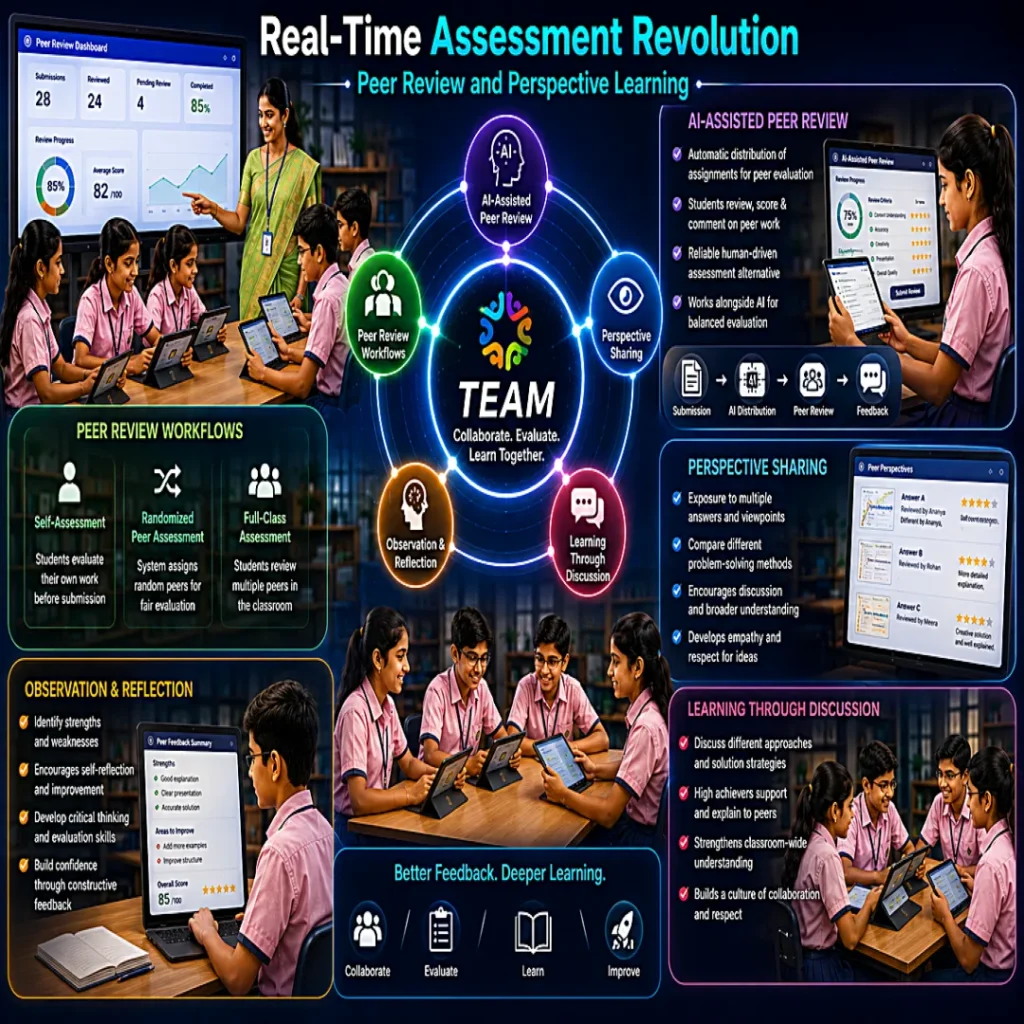
- Peer Review enables students to exchange, evaluate, and comment on each other’s subjective assignments including text responses, mathematical calculations, pictures, and audio recordings. By participating in collaborative evaluation activities, students develop reflection, observation, and deeper understanding through peer interaction.
- The system supports self-assessment, randomized peer assessment, and full-class assessment workflows, allowing collaborative evaluation to become part of everyday classroom learning.
- Once student submissions are collected, the system can automatically distribute assignments to other students for evaluation. Students can review peer work, assign scores, provide comments, and submit feedback directly within the classroom workflow.
- Peer Review also provides a reliable human-driven assessment alternative in situations where AI-based automated evaluation may not be practical.
By observing different answers, problem-solving approaches, and viewpoints, students gain exposure to multiple ways of thinking and expressing ideas. This encourages comparison, discussion, and broader understanding.
Reviewing peer submissions helps students identify strengths, weaknesses, and areas for improvement while encouraging self-reflection and continuous learning improvement.
Peer Review supports collaborative classroom learning by encouraging discussion around evaluation standards, reasoning processes, and alternative approaches. High-achieving students can support peers through explanation and shared learning experiences, strengthening classroom-wide understanding.
Smarter Teaching Through Differentiated Learning
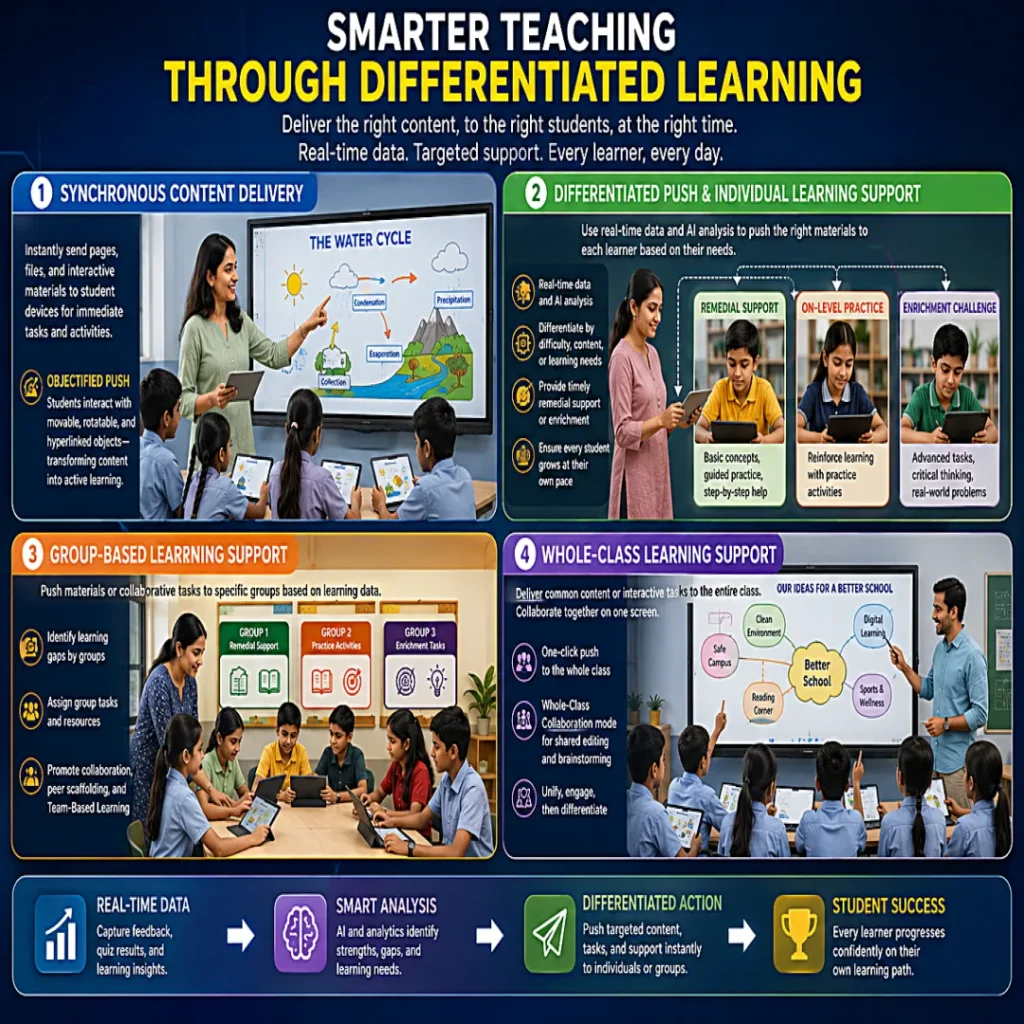
Students within the same classroom often differ in learning pace, ability levels, interests, and support requirements. TEAM supports Synchronous Differentiated Instruction (SDI), enabling teachers to dynamically adapt instruction and learning materials based on real-time classroom feedback and learning data.
By combining interactive participation, AI-assisted analysis, and differentiated content delivery, TEAM helps teachers provide targeted learning support without disrupting overall classroom continuity.
Teachers can instantly deliver lesson pages, files, and learning materials directly to student devices for immediate classroom activities and guided learning tasks.
A key capability within this process is Objectified Push, where students can interact with movable, rotatable, and hyperlinked graphical objects directly on their devices. This transforms learning from passive content viewing into active knowledge exploration and task-based interaction.
Teachers can instantly distribute learning materials with different difficulty levels, targeted remedial support, or extended enrichment content to individual students or selected learners based on their learning needs and classroom performance.
Differentiated Push enables teachers to dynamically adapt instruction during live classroom teaching using real-time classroom feedback, quiz statistics, and AI analysis results.
Teachers can distribute collaborative tasks, remedial resources, and differentiated learning materials to selected student groups based on classroom learning data.
This supports Team-Based Learning (TBL), peer scaffolding, collaborative problem-solving, and targeted group intervention within the same classroom environment.
While TEAM supports granular differentiated instruction, it also enables unified classroom learning experiences. Teachers can instantly deliver common learning materials, interactive tasks, and collaborative activities to the entire class simultaneously.
The Whole-Class Collaboration mode allows teachers and students to share and co-edit the same collaboration screen, supporting collective brainstorming, classroom discussion, and shared knowledge construction before transitioning into differentiated learning activities.
Differentiated Collaboration
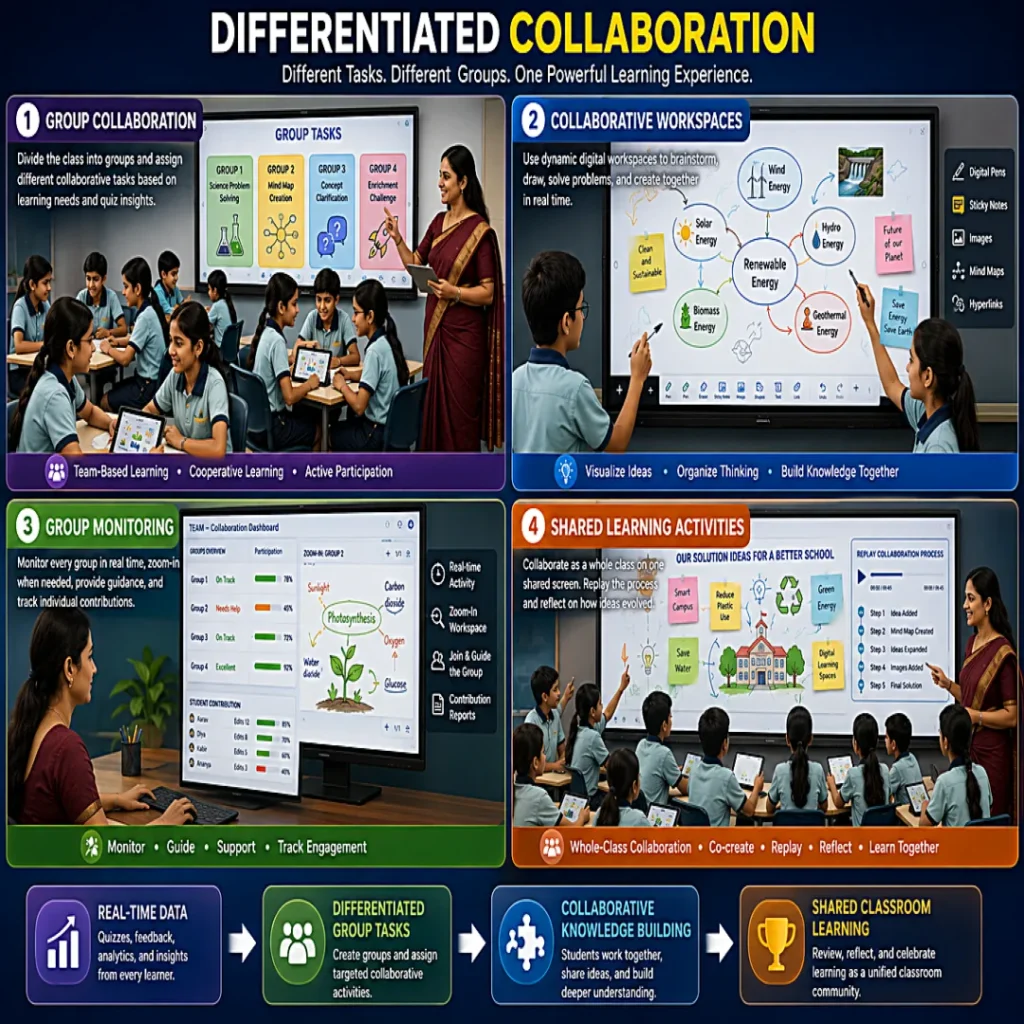
Differentiated Collaboration is a distinctive capability of the TEAM system that enables teachers to assign different collaborative tasks to different student groups simultaneously. Using real-time classroom feedback, quiz statistics, and learning analysis results, teachers can dynamically group students and initiate targeted collaborative activities based on specific learning needs and misconceptions.
This transforms collaboration from a generic group activity into a data-driven learning strategy that supports differentiated instruction, peer interaction, and deeper classroom engagement.
TEAM enables classrooms to be organized into multiple collaborative groups where each team works on its own assigned task or learning objective. This strongly supports Team-Based Learning (TBL) and cooperative learning environments by allowing students to contribute through their personal devices while discussing and solving problems collaboratively within their groups.
The platform provides interactive digital collaboration spaces where students can brainstorm, draw, solve problems, and organize ideas together in real time.
Students can use digital pens, sticky notes, images, and collaborative Mind Maps to visualize thinking processes, organize ideas, and collectively construct knowledge within shared digital workspaces.
Teachers can monitor every group’s collaboration activities and participation status in real time throughout the learning process.
Using the Zoom-In feature, teachers can closely observe a specific group’s workspace, participate directly when guidance is needed, and track individual student contributions through detailed activity records and collaboration reports.
TEAM also supports large-scale collaborative learning through Whole-Class Collaboration mode, where teachers and students share and co-edit the same collaboration screen simultaneously.
The system can replay the entire collaboration process step-by-step, enabling students and teachers to review how ideas evolved and how the final collaborative outcome was constructed collectively.
Cloud-Based IES Academic Management Module (LMS)
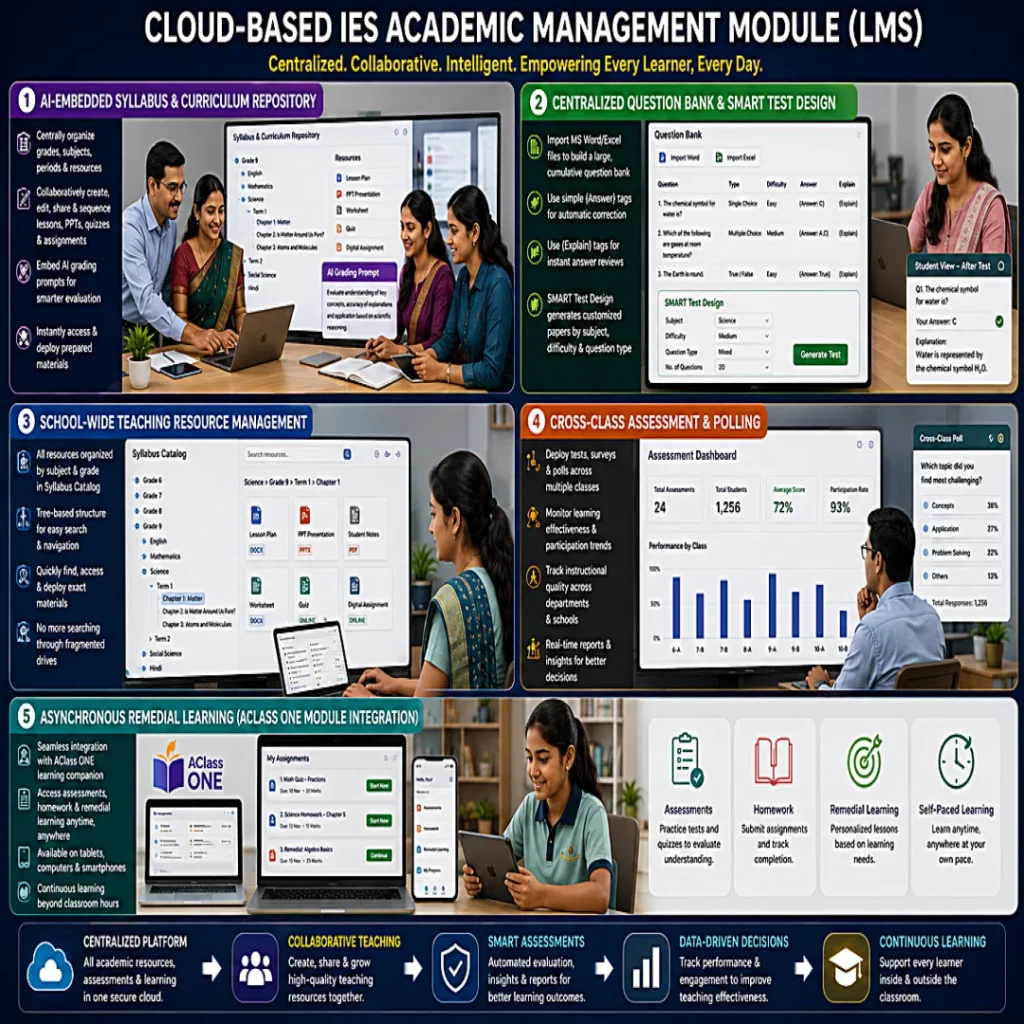
The Cloud-Based IES Academic Management Module (LMS) serves as the centralized academic management and collaborative teaching backbone of the TEAM ecosystem. It integrates curriculum management, teaching resources, assessment workflows, question banks, and asynchronous learning into one unified cloud platform.
By organizing school-wide academic resources into structured subject and syllabus-based repositories, the platform helps schools standardize teaching quality, support collaborative lesson preparation across departments and grade levels, thereby reducing repetitive teacher workload.
AI-Embedded Syllabus & Curriculum Repository:
The platform provides a highly structured syllabus and curriculum repository where administrators can centrally organize grades, subjects, periods, and teaching resources.
Teaching teams can collaboratively create, edit, share, and sequence lesson materials, presentations, quizzes, and digital assignments to build continuously growing school-based teaching resources. By relying on this shared repository, teachers can instantly access and deploy prepared materials without repetitive daily lesson preparation.
Teachers can also embed AI grading prompts directly into shared assignments and syllabus materials, enabling AI-assisted evaluation workflows within the curriculum structure itself.
Centralized Question Bank & SMART Test Design:
The platform enables schools to build large cumulative digital question banks by directly importing MS Word and Excel files without manual data entry.
Teachers can define objective question answers using simple tagging formats, allowing the system to automatically correct submissions. Embedded explanation tags also enable students to instantly view detailed answer reviews after assessments.
Using this centralized repository, SMART Test Design can automatically generate customized test papers based on subject, difficulty level, and selected question types.
School-Wide Teaching Resource Management:
All teaching materials, assessments, and digital resources are centrally organized by subject and grade level within the Syllabus Catalog structure.
Using intuitive tree-based resource management, teachers can quickly locate, access, and deploy the exact teaching materials, presentations, and assessments needed for their classroom activities without searching through fragmented storage systems.
Cross-Class Assessment & Polling:
The IES platform enables administrators and educators to deploy standardized assessments, surveys, and polling activities across multiple classes simultaneously.
This centralized assessment capability supports systematic monitoring of learning effectiveness, participation trends, and instructional quality across classes, academic departments and schools
Asynchronous Remedial Learning (AClass ONE Module Integration):
The IES ecosystem extends learning beyond classroom hours through seamless integration with the AClass ONE learning companion module.
Students can access assessments, homework, remedial learning activities, and self-paced learning resources from tablets, computers, or smartphones, enabling continuous learning support beyond synchronous classroom instruction.
Cloud-Based AClass ONE – Post-Class Extension: Achieving Individualized Precision Learning Paths
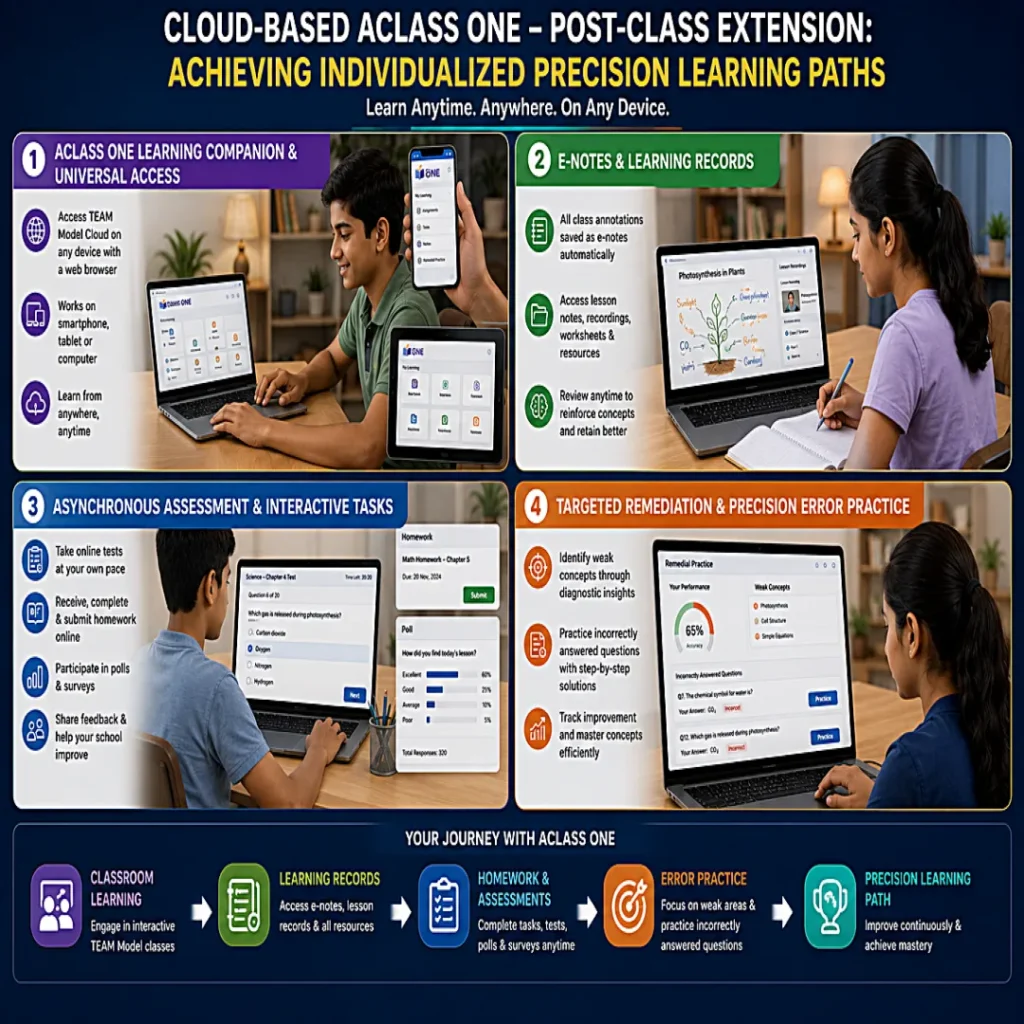
Learning does not end when classroom instruction concludes. Cloud-Based AClass ONE extends the TEAM learning ecosystem beyond synchronous classroom teaching by enabling continuous, self-directed, and personalized learning from anywhere.
By combining universal device accessibility, asynchronous assessments, digital learning records, homework management, and precision remedial learning, AClass ONE helps schools support continuous learning pathways tailored to each student’s individual learning progress and needs.
AClass ONE Learning Companion & Universal Access:
Universal Multi-Device Accessibility: The AClass ONE Learning Companion breaks the boundaries of the physical classroom by allowing students to access the TEAM Model Cloud using any device equipped with a web browser.
Whether utilizing a tablet, personal computer, or smartphone, students can seamlessly log in from anywhere without requiring specialized software installations to access learning resources, complete activities, and continue learning.
E-Notes and Learning Records: AClass ONE also serves as a personalized digital learning archive where classroom annotations, interactive activities, and lesson records are automatically saved as e-notes. Students can revisit these learning records after class to review lessons, reinforce understanding, and consolidate learning at their own pace.
Asynchronous Assessment & Interactive Tasks:
AClass ONE supports asynchronous online assessments that allow students to complete tests independently outside regular classroom hours.
The platform also streamlines homework management by enabling students to receive, complete, and submit assignments directly through their preferred devices. In addition, schools can deploy online polls and surveys to gather feedback and conduct learning-related data collection beyond classroom instruction.
Targeted Remediation & Precision Error Practice:
AClass ONE supports highly individualized remedial learning by helping students identify and focus specifically on their learning weaknesses following assessments.
Instead of reviewing all content uniformly, students can directly revisit and practice incorrectly answered questions, enabling highly targeted remedial learning and more efficient mastery of concepts that require additional attention.
HiTA – TEAM Teacher App: The Wireless Smart Teaching Assistant
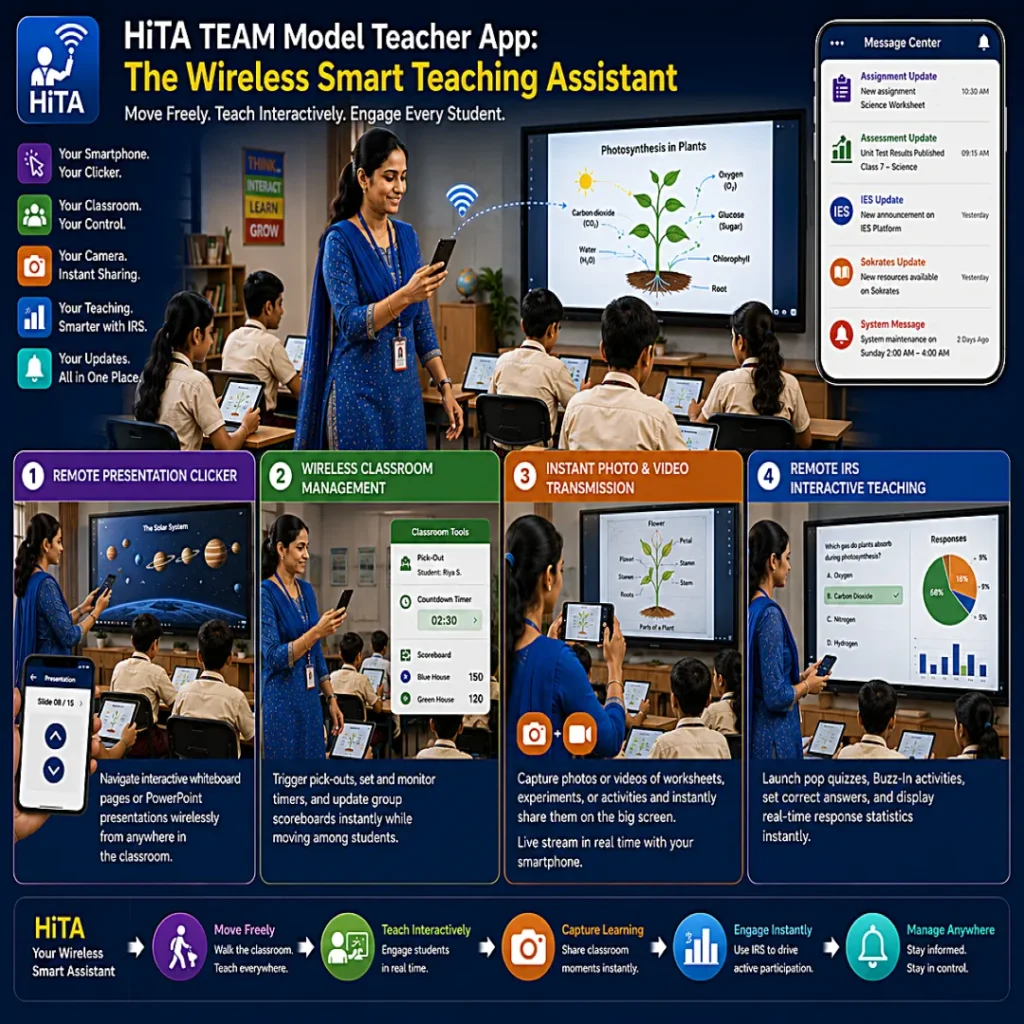
HiTA transforms the teacher’s smartphone into a powerful wireless teaching assistant, enabling educators to move freely throughout the classroom while maintaining complete control over teaching, interaction, classroom activities, and learning resources.
By combining wireless presentation control, classroom management tools, instant media sharing, remote interactive teaching, and centralized notifications, HiTA helps teachers create more dynamic, mobile, and engaging classroom experiences.
Remote Presentation Clicker:
HiTA frees teachers from being confined to the podium by turning their smartphone into a wireless presentation controller.
Teachers can remotely navigate interactive whiteboard pages, lesson materials, and PowerPoint presentations while moving naturally around the classroom and interacting more closely with students.
Wireless Classroom Management:
HiTA provides instant access to essential classroom management functions directly from the teacher’s smartphone.
Teachers can remotely initiate student pick-outs, manage countdown timers, monitor classroom activities, and update group scoreboards without interrupting lesson flow, enabling smoother and more interactive classroom management.
Instant Photo & Video Transmission:
HiTA eliminates the need for traditional document cameras by allowing teachers to instantly capture and share classroom content directly from their smartphones.
Teachers can photograph student work, teaching materials, experiments, and classroom activities, then immediately display them on the interactive screen for observation, discussion, and feedback. The app also supports live camera streaming, transforming the smartphone into a wireless visual presenter.
Remote IRS Interactive Teaching:
Integrated with the Interactive Response System (IRS), HiTA enables teachers to remotely launch quizzes, initiate Buzz-In activities, set correct answers, and instantly display classroom response statistics.
This allows teachers to manage interactive learning activities from anywhere in the classroom while maintaining continuous student engagement.
Centralized Message Center:
HiTA serves as a centralized notification hub that keeps teachers informed about learning activities, assignments, assessments, and platform updates.
By consolidating important classroom and platform information into a single location, teachers can stay connected to ongoing learning activities and system communications throughout the school day.
TEAM – Five Generative AI Features: The World’s Only Multi-AI Teaching Engine
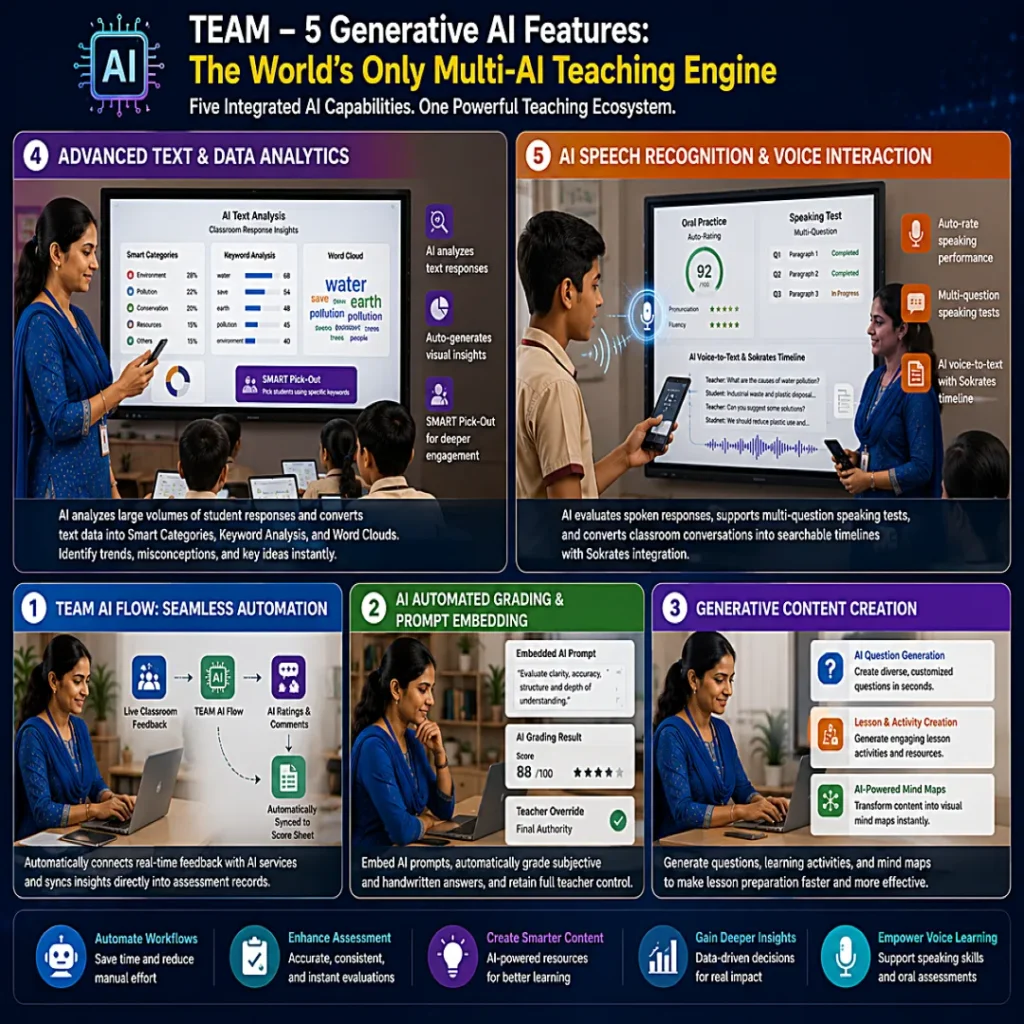
While many educational platforms offer isolated AI tools, TEAM integrates multiple Generative AI capabilities directly into teaching, assessment, classroom interaction, learning analytics, and instructional decision-making.
Together, these five integrated AI capabilities create a comprehensive Multi-AI Teaching Engine designed specifically for educational environments.
1. TEAM AI Flow: Seamless Automation:
Automatically connects real-time classroom feedback data with Generative AI services, eliminating repetitive manual workflows and synchronizing AI-generated insights directly into classroom assessment records.
2. AI Automated Grading & Prompt Embedding:
Enables teachers to embed customized AI grading prompts into assignments and assessments, supporting automated evaluation of subjective and handwritten responses while preserving full teacher control.
3. Generative Content Creation:
Assists teachers in generating instructional resources, customized questions, assessment activities, and visual knowledge structures such as Mind Maps to support lesson preparation and classroom learning.
4. Advanced Text & Data Analytics:
Large volumes of student-generated text and open-ended responses can be difficult to analyze during live classroom instruction. TEAM AI rapidly processes classroom feedback and automatically transforms text data into meaningful visual insights.
5. AI Text Analysis:
The system analyzes student responses and identifies common themes, concepts, and emerging learning patterns, helping teachers understand classroom thinking more efficiently.
Automated Visual Insights:
TEAM AI automatically converts text responses into:
- Smart Categories
- Keyword Analysis
- Word Cloud Analysis
These visual representations help teachers quickly identify misconceptions, learning trends, and important discussion points. Teachers can also use these AI-generated insights to initiate SMART Pick-Out activities and deepen classroom discussions.
5. AI Speech Recognition & Voice Interaction:
TEAM AI extends learning beyond written responses by supporting AI-powered speech recognition and voice-based assessment activities.
Oral Practice Auto-Rating:
Students can participate in speaking exercises and pronunciation activities while AI automatically evaluates fluency and speaking performance, providing immediate feedback.
Multi-Question Speaking Tests:
The system can automatically divide longer reading passages into multiple speaking assessment tasks, enabling structured oral evaluations within a single activity.
AI Voice-to-Text & Sokrates Timeline:
Integrated with the Sokrates platform, AI Voice-to-Text technology creates searchable records of classroom interactions, allowing teachers to review and analyze teaching and learning conversations throughout the lesson.
Classroom Productivity and Interactive Teaching Tools
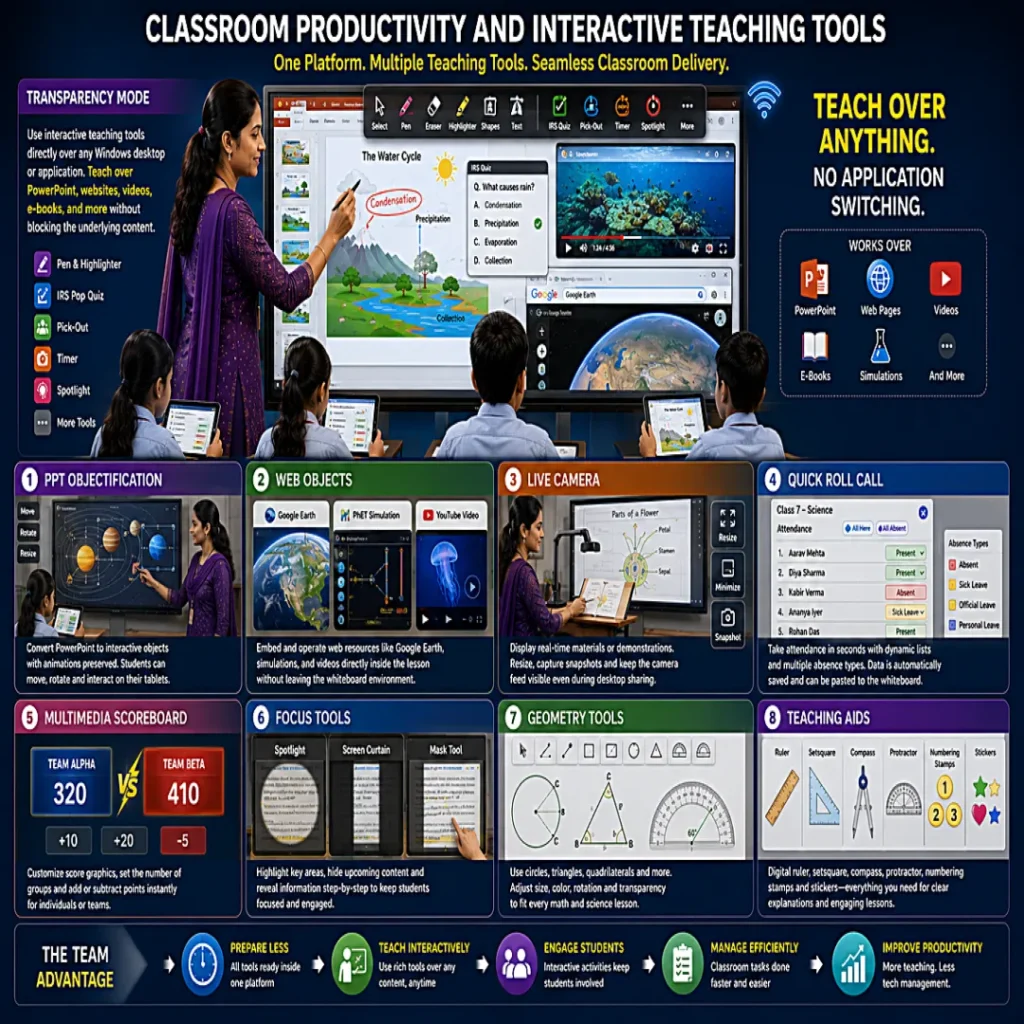
TEAM includes built-in classroom productivity and interactive teaching tools that help teachers deliver richer lessons, manage classroom activities, and avoid switching between multiple separate applications during live teaching.
Featured Interactive Teaching Capabilities:
Transparency Mode:
Transparency Mode allows teachers to use TEAM’s interactive toolbar directly over the Windows desktop. Teachers can annotate, launch IRS pop quizzes, use Pick-Out, set timers, and access teaching tools over PowerPoint presentations, e-books, web pages, videos, or third-party applications without blocking the underlying content.
PPT Objectification:
PPT Objectification converts PowerPoint files into editable whiteboard pages while preserving animations such as appear, fade, pulse, and zoom. Text and images become movable learning objects, allowing students to manipulate, rotate, and interact with content on their tablets when the page is pushed to them.
Web Objects:
Web Objects allow teachers to embed and operate live web resources URLs directly inside teaching pages. Simulations, videos, maps, and online learning resources can be used within the whiteboard environment without leaving the lesson flow.
Live Camera:
Live Camera enables teachers to display real-time physical materials, experiments, handwritten work, or demonstrations using USB or document cameras. Teachers can resize the live video, capture snapshots into the whiteboard, and keep the camera feed visible even during desktop sharing or remote teaching.
Classroom Management & Teaching Aids:
- Quick Roll Call: Record attendance using dynamic or preset student lists, including absence, sick leave, official leave, and personal leave.
- Multimedia Scoreboard: Add or subtract points for individual students or groups using customizable score graphics.
- Focus Tools: Use Spotlight, Screen Curtain, and Mask tools to guide attention and reveal content progressively.
- Geometry Tools: Use adjustable digital shapes such as circles, triangles, and quadrilaterals for mathematics and visual instruction.
- Teaching Aids: Use digital ruler, setsquare, compass, protractor, numbering stamps, and stickers for classroom demonstrations and visual organization
Game-Based Learning (Gamification)
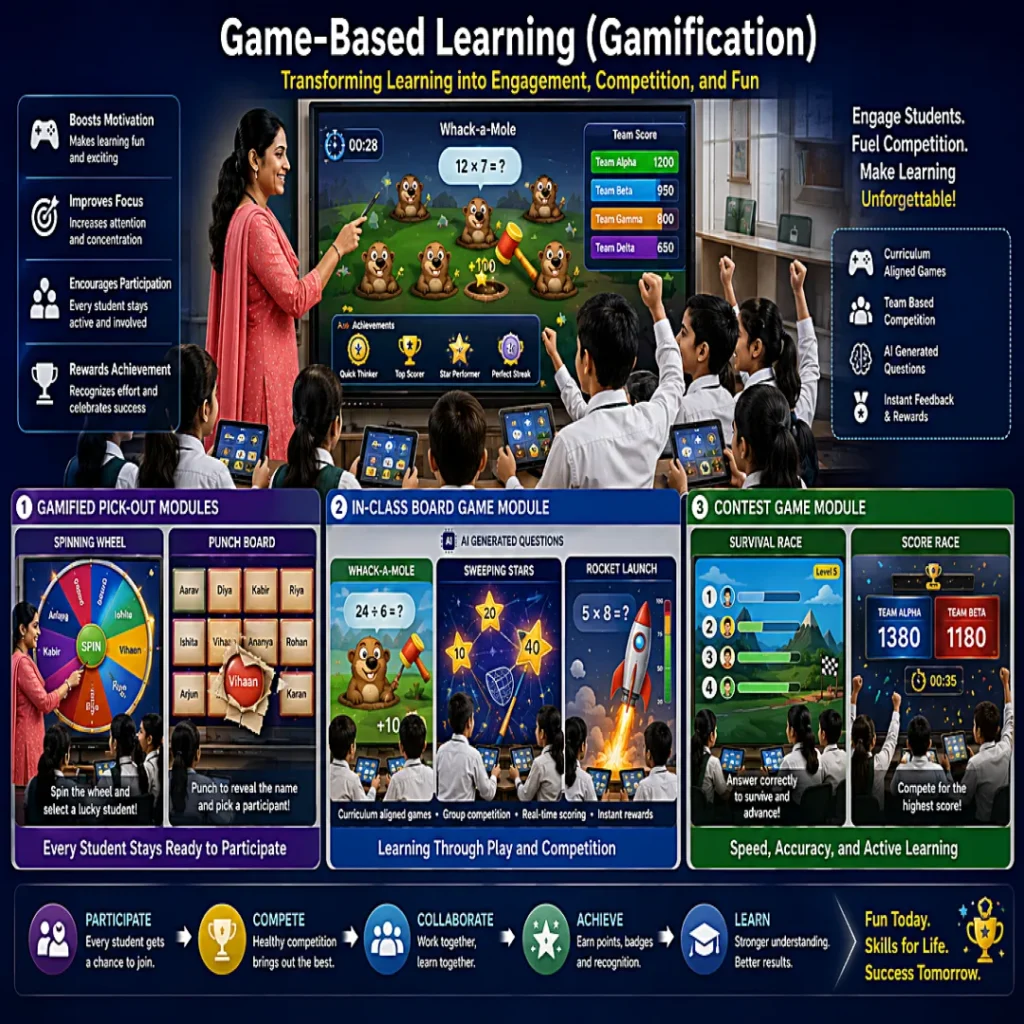
Educational research consistently shows that Game-Based Learning (GBL) increases student motivation, improves concentration, and encourages active participation. TEAM integrates game-based learning directly into classroom instruction, combining competition, challenge, collaboration, and rewards to create engaging learning experiences while maintaining clear educational objectives.
Gamified Pick-Out Modules:
TEAM transforms routine classroom participation into exciting learning moments through interactive student selection activities. Gamified Pick-Out tools introduce anticipation, fun, and engagement while encouraging all students to remain attentive and ready to participate.
In-Class Board Game Module:
TEAM incorporates curriculum-aligned educational games that combine learning with friendly competition. Teachers can integrate lesson content directly into classroom games, enabling students to reinforce concepts, practice skills, and collaborate with peers through highly engaging learning activities.
Contest Game Module:
For structured competitive learning, TEAM provides contest-based game formats that challenge students to demonstrate both speed and accuracy. These activities create a high-energy classroom environment while helping teachers assess understanding and reinforce learning outcomes.
Teacher Growth Through AI Sokrates module
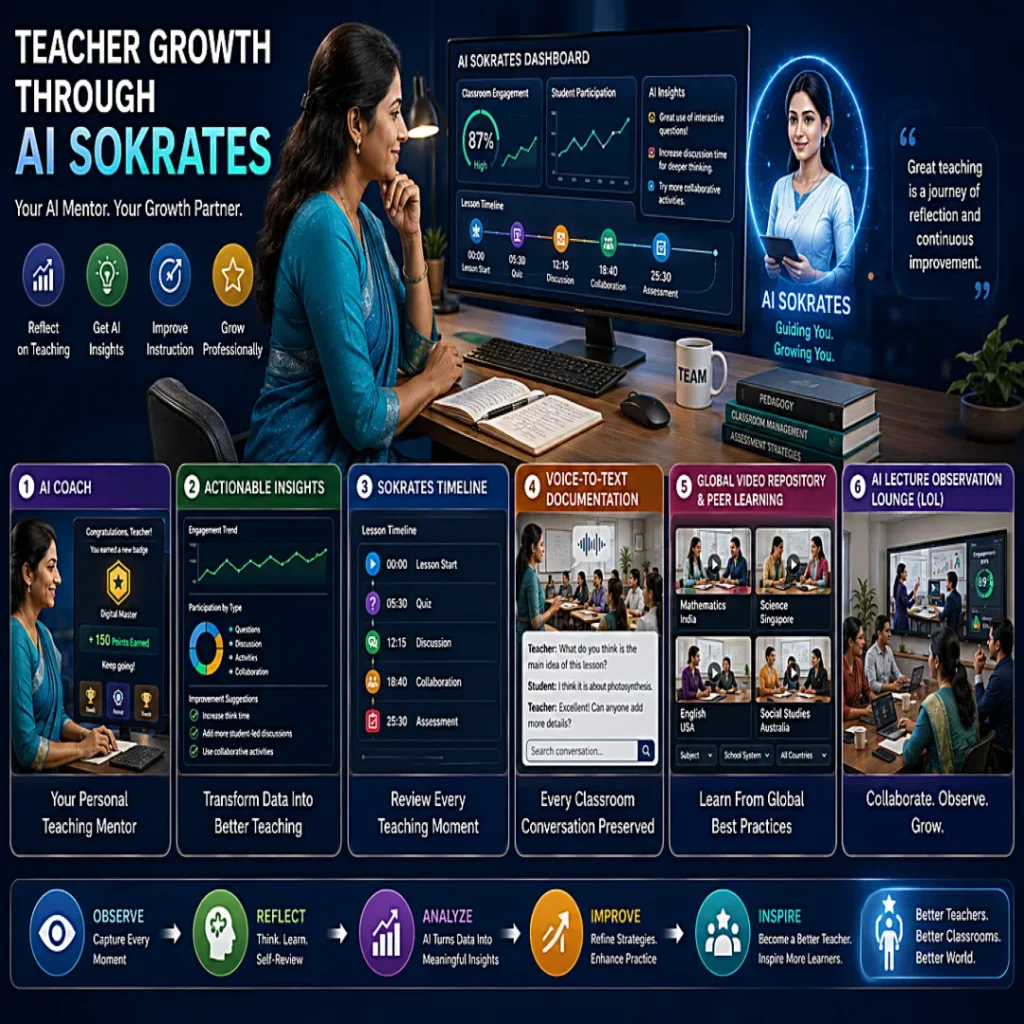
AI Sokrates is the teacher professional growth module within the TEAM ecosystem, designed to support lesson observation, pedagogical reflection, digital teaching skill development, and continuous instructional improvement.
By combining AI analysis, classroom interaction records, lesson timelines, voice-to-text documentation, peer learning resources, and structured observation environments, Sokrates serves as an intelligent mentor for teachers and a professional development platform for schools.
AI Coach:
Sokrates includes an AI Coach that supports teacher growth by encouraging educators to learn, master, and apply TEAM tools and teaching features.
Through points and incentive mechanisms, teachers are motivated to continuously improve their digital teaching skills and adopt more effective classroom practices.
Actionable Insights:
Sokrates uses AI to analyze teaching behaviors and classroom interaction records, providing teachers with data-driven insights that support meaningful reflection.
These insights help educators refine instructional methods, improve classroom engagement, and make teaching improvement more evidence-based.
Data-Driven Reflection:
The Sokrates timeline records the chronological flow of each lesson, enabling teachers and trainers to review how the class unfolded.
Teachers can revisit instructional events, digital tool usage, classroom interactions, and pedagogical strategies to support lesson study and professional reflection.
Classroom Interaction Records:
Sokrates automatically captures comprehensive classroom data, including attendance, scoring, interactive learning, task execution, assessment results, and collaborative contributions.
This creates a complete record of teaching and learning activity, helping teachers understand whole-class learning performance and student engagement more clearly.
Voice-to-Text Documentation:
Integrated AI Voice-to-Text converts classroom dialogue into a searchable text record of teacher-student interaction.
This allows teachers and observers to review the exact flow of classroom communication, identify important teaching moments, and conduct deeper post-lesson analysis.
Global Video Repository and Peer Learning:
Sokrates also functions as a global peer learning hub by collecting actual teaching videos, lesson plans, and application examples from educators across different subjects and school systems.
Teachers can learn from practical classroom examples, observe how peers apply TEAM tools, and improve their own digital teaching practice more efficiently.
AI Lecture Observation Lounges:
Schools can use Sokrates to establish AI Lecture Observation Lounges or specialized lesson study classrooms.
These structured environments support collaborative observation, long-term teacher development, and the transition toward competence-oriented teaching.
Learning Analytics and Data-Driven Educational Decisions
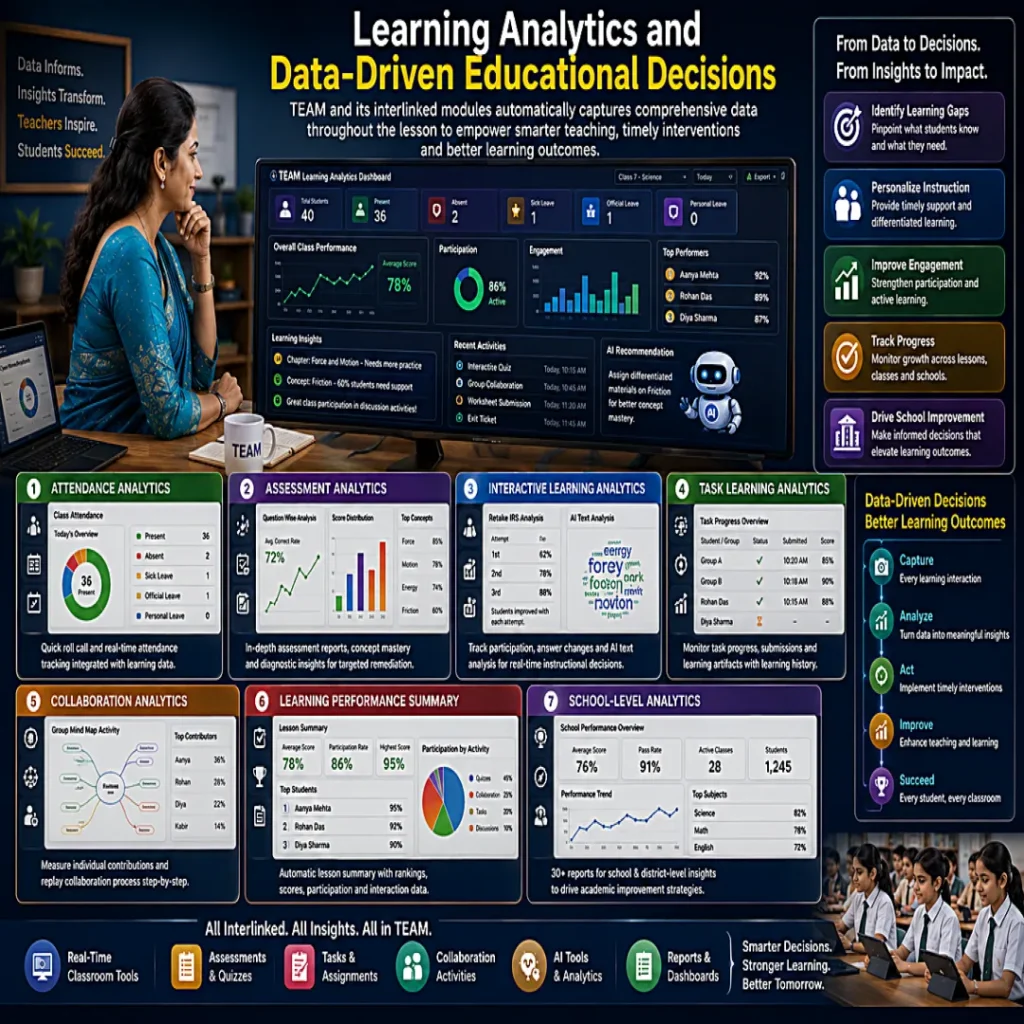
TEAM and its interlinked modules automatically captures learning data throughout the teaching and learning process, transforming classroom interactions, assessments, tasks, collaboration activities, and school-wide evaluations into meaningful insights.
By integrating learning analytics directly into daily teaching activities, TEAM enables educators and school leaders to make informed instructional decisions, identify learning gaps, monitor progress, and implement targeted interventions more effectively.
Key Learning Analytics Capabilities:
Attendance Analytics:
Track attendance, absences, and participation records as part of the overall learning profile.
Assessment Analytics:
Analyze performance trends, grade distributions, concept mastery, and learning gaps.
Interactive Learning Analytics:
Monitor participation patterns, response distributions, thinking changes, and AI-generated text analysis.
Task Learning Analytics:
Track task completion, work submissions, progress history, and learning artifacts.
Collaboration Analytics:
Measure individual contributions, engagement levels, and collaborative learning performance.
Learning Performance Summary:
Automatically generate lesson-level summaries, participation rankings, assessment results, and learning records.
School-Level Analytics:
Support school-wide and district-level monitoring through cross-class assessments, surveys, polling, and multi-dimensional analysis reports.
Building AI-Assisted Smarter Schools Without Compromising Educational Values
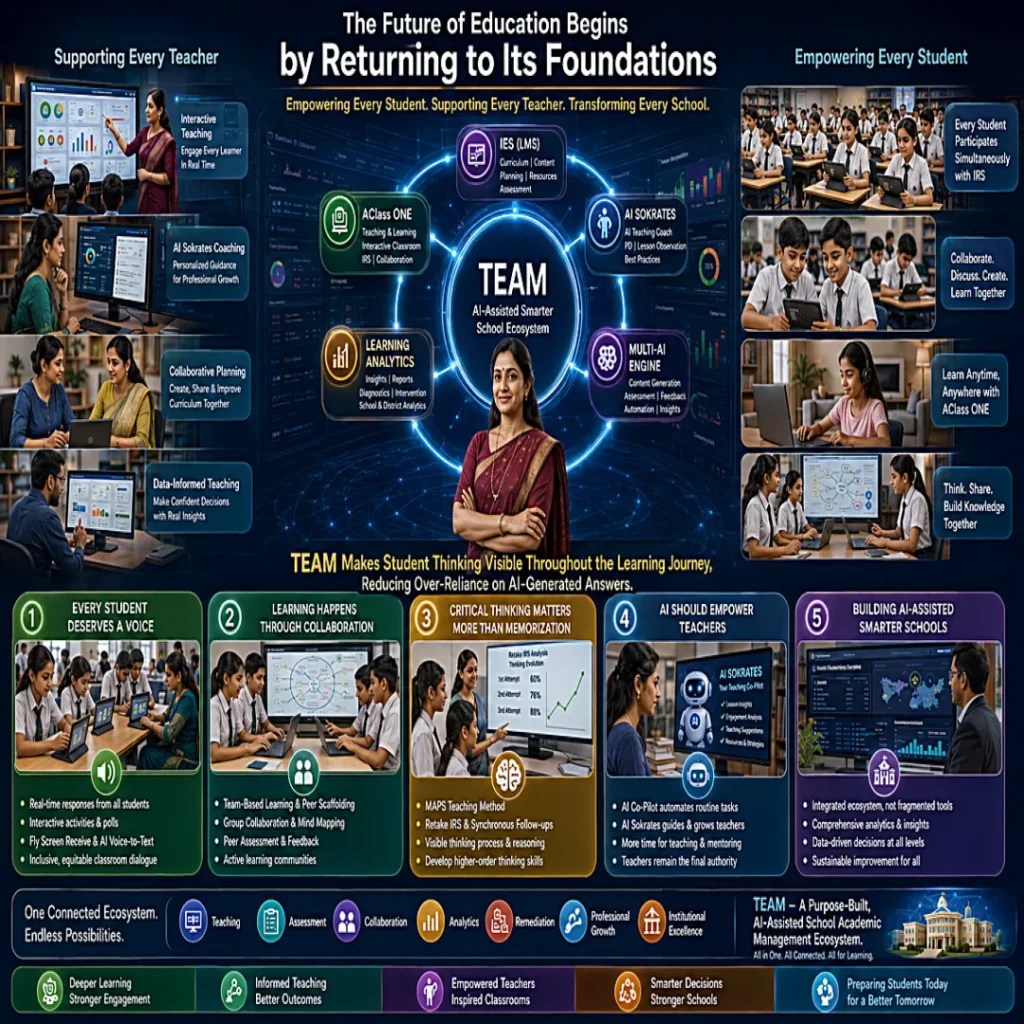
Technology alone does not transform education. Meaningful learning occurs when teachers understand students, students learn from one another, critical thinking is cultivated, and technology supports rather than replaces human interaction.
The TEAM ecosystem is designed around this principle. By seamlessly connecting pre-class preparation, classroom learning, assessment, remediation, collaboration, learning analytics, and professional development into a unified environment, TEAM helps schools harness the power of AI while preserving the human foundations of education.
Traditional classrooms often rely on the participation of a few vocal students while many others remain unheard. TEAM restores meaningful two-way dialogue by enabling every student to participate simultaneously through real-time feedback, interactive activities, collaborative learning, and continuous classroom communication. This ensures that every learner can contribute, be understood, and receive timely support, creating a more inclusive and engaging learning environment.
Deep learning is strengthened when students exchange ideas, solve problems together, and learn from different perspectives.
Through collaborative workspaces, peer assessment, team-based learning, collaborative mind maps, and shared knowledge construction, TEAM transforms classrooms into active learning communities where students learn both with and from one another.
In an AI-driven world, the ability to think, question, analyze, evaluate, and justify ideas becomes increasingly important.
Through structured dialogue, mind mapping, follow-up questioning, reflection activities, and visible thinking processes, TEAM helps students develop higher-order thinking skills that extend far beyond factual recall.
By making student thinking visible throughout the learning journey, TEAM helps schools reduce over-reliance on AI-generated answers while encouraging deeper understanding, stronger critical thinking, and meaningful competency development.
The most effective use of AI is not automation for its own sake, but empowering teachers to focus on teaching, mentoring, and student growth.
TEAM’s Multi-AI Teaching Engine reduces repetitive workload by supporting assessment, content creation, data analysis, classroom interaction, and instructional decision-making while ensuring that teachers remain the final decision-makers in every learning process.
At the same time, AI Sokrates acts as an intelligent professional growth companion that continuously helps teachers discover, master, and effectively utilize TEAM’s teaching tools and classroom strategies. Through AI coaching, lesson observation, peer learning resources, classroom analytics, and data-driven reflection, teachers are supported in continuously refining both their digital teaching competencies and classroom practices. This allows educators to spend less time on administrative tasks and more time on what matters most—teaching innovation, personalized guidance, and meaningful student engagement
The future of education requires more than isolated digital tools. Schools need connected ecosystems that link teaching, learning, assessment, remediation, analytics, professional development, and institutional improvement.
Rather than relying on fragmented educational technologies, TEAM provides a purpose-built AI-assisted School Academic Management Ecosystem that integrates teaching, assessment, collaboration, learning analytics, teacher development, and institutional management into a single connected environment.
Through TEAM and its interlinked modules—including IES (LMS), AClass ONE, AI Sokrates, PLAYTOL Learning Analytics, and the Multi-AI Teaching Engine—schools can confidently adopt AI-assisted learning while continuously monitoring participation, engagement, competency development, and learning outcomes.
The result is a sustainable, data-driven educational environment that empowers teachers, supports students, informs school leaders, and systematically prepares institutions for the future of education.
TEAM is more than an educational technology platform. It is a purpose-built AI-assisted School Academic Management Ecosystem designed to help schools improve learning outcomes, strengthen teacher effectiveness, make data-driven decisions, and confidently embrace the future of education while staying true to the fundamental purpose of education—supporting the growth and success of every learner.
Frequently Asked Questions?
No. TEAM’s IRS-BYOD environment operates through a standard web browser. Students can participate using tablets, laptops, desktop computers, or smartphones without downloading or installing additional applications, making deployment simple and maintenance-free.
TEAM supports tablets, laptops, desktop computers, and smartphones. Students can access learning activities, assessments, collaboration tools, and AClass ONE learning resources using any device equipped with a web browser.
TEAM’s dual-device participation feature allows students to attend live online or blended classes using a desktop, laptop, or tablet while simultaneously using a smartphone for real-time answering, quizzes, polls, and interactive activities.
This feature improves engagement by combining uninterrupted content viewing on a larger screen with fast and intuitive touch-screen interaction on a mobile device. As a result, students can participate more actively, respond instantly, and remain continuously engaged throughout the learning session.
Yes. TEAM is designed to support unified blended learning environments where classroom and remote students can participate in the same lesson, activities, assessments, and collaborative learning experiences simultaneously.
Yes. TEAM supports students across all grade levels. Younger learners can participate using durable TEAM Clickers designed for simple classroom interaction, while older students can utilize tablets, laptops, and smartphones for more advanced learning activities and assessments.
TEAM utilizes AI to support assessment, content creation, learning analytics, classroom interaction, and teacher development. Through purpose-built TEAM workflows, prompts, and educational processes, AI assists teachers in performing tasks more efficiently while ensuring that educators remain in full control of teaching, assessment, and instructional decision-making.
Yes. TEAM follows a Human-in-the-Loop approach. Teachers can review, adjust, modify, or override AI-generated scores, comments, and feedback at any time, ensuring that professional judgment always remains central to the assessment process.
TEAM makes student thinking visible throughout the learning journey. Through real-time participation, follow-up questioning, collaborative activities, formative assessment, peer review, and learning analytics, teachers gain insight into both student answers and the reasoning behind them. This encourages deeper understanding, critical thinking, reflection, and genuine competency development rather than reliance on AI-generated responses alone.
TEAM enables teachers to instantly provide different learning materials, activities, and support based on real-time classroom data. Individual students, specific groups, or the entire class can receive targeted learning resources appropriate to their learning needs and progress levels.
TEAM includes collaborative workspaces, group collaboration, collaborative mind maps, peer assessment, and whole-class collaboration tools. These features encourage students to learn from one another, exchange perspectives, and actively construct knowledge together.
The AI Sokrates module continuously supports teacher growth through AI coaching, lesson observation, peer learning resources, classroom analytics, and data-driven reflection. Teachers receive guidance that helps them improve instructional practices while mastering TEAM tools and teaching strategies.
TEAM and its interlinked modules automatically capture attendance, assessment, participation, task, collaboration, and school-level analytics. These insights help teachers identify learning gaps, monitor progress, provide targeted intervention, and make evidence-based instructional decisions.
Through IES, PLAYTOL Learning Analytics, AI Sokrates, and TEAM’s integrated reporting capabilities, school leaders can monitor learning effectiveness, assessment performance, participation trends, teacher development, and institutional improvement initiatives across the entire school.
A conventional LMS primarily focuses on content delivery and assignment management. TEAM is a purpose-built AI-assisted School Academic Management Ecosystem that integrates classroom interaction, assessment, collaboration, learning analytics, teacher professional development, AI-assisted teaching, LMS capabilities, and post-class learning into a single connected environment.
Yes. TEAM supports phased implementation. Schools can begin with selected grades or pilot programs, evaluate outcomes, and then expand deployment across the institution based on their adoption strategy and objectives.
TEAM AI-Assisted School Ecosystem vs Conventional Educational Technologies
| Educational Need | ❌ Conventional Educational Technologies | ✅ TEAM AI-Assisted School Ecosystem |
| 👥 Student Participation | Participation often limited to a small group of active students. | Every student participates simultaneously through real-time interactive learning. |
| 💡 Visibility of Student Thinking | Final answers are visible, but the learning process often remains hidden. | Student thinking becomes visible throughout the learning journey through participation, dialogue, assessment, and analytics. |
| 🌐 Classroom & Remote Learning | Classroom and online learning frequently require separate systems. | Unified blended learning environment supporting classroom and remote learners simultaneously. |
| 🎯 Differentiated Learning | Differentiation is largely manual and difficult to manage at scale. | Real-time differentiated learning support based on classroom data and learner needs. |
| 🤝 Collaborative Learning | Often dependent on external collaboration tools. | Built-in collaborative learning ecosystem including group workspaces, peer review, and collaborative mind maps. |
| 📝 Assessment | Assessment tools are typically separate from classroom teaching. | Continuous classroom-integrated assessment environment. |
| ⚡ Subjective Evaluation | Significant teacher grading workload. | AI-assisted grading with full teacher review and override control. |
| 🔄 Peer Review & Reflection | Rarely supported within everyday classroom workflows. | Fully integrated peer review, reflection, and perspective-sharing activities. |
| 📊 Learning Analytics | Reports are fragmented across multiple systems. | Unified analytics covering participation, assessment, collaboration, tasks, and learning performance. |
| 👨🏫 Teacher Professional Growth | Professional development is usually disconnected from classroom practice. | Continuous teacher support through AI Sokrates, coaching, lesson reflection, and peer learning. |
| 📚 Curriculum & Resource Management | Teaching resources are distributed across multiple locations and platforms. | Centralized curriculum, syllabus, assessment, and resource management through IES. |
| 🏠 Post-Class Learning | Learning often stops when classroom instruction ends. | Continuous learning support through AClass ONE with homework, remediation, assessments, and learning records. |
| 🤖 AI Adoption | Standalone AI tools require manual workflows and copy-paste processes. | TEAM-guided AI integrated directly into teaching, assessment, analytics, and learning workflows. |
| 🏫 School-Wide Visibility | Limited visibility into overall learning effectiveness and teaching quality. | Institution-wide academic analytics and decision-support insights for school leaders. |
| 🔗 Educational Technology Infrastructure | Multiple disconnected platforms requiring separate management. | One connected AI-assisted School Academic Management Ecosystem. |
Why Schools Should Move Beyond Fragmented Educational Solutions to TEAM
Educational institutions today face increasing pressure to improve student engagement, strengthen learning outcomes, support teachers, adopt AI responsibly, and make data-driven decisions—all while managing multiple disconnected technologies.
TEAM addresses these challenges through a unified educational ecosystem that seamlessly connects teaching, assessment, collaboration, learning analytics, teacher development, and AI-assisted learning within a single platform.
Schools Choose TEAM Because It Delivers:
✓ Every Student Participates
✓ Real-Time Classroom Interaction and Feedback
✓ Unified Blended Learning Experiences
✓ AI-Assisted Teaching and Assessment
✓ Built-In Learning Analytics and Educational Insights
✓ Continuous Teacher Professional Growth
✓ Safe and Responsible AI Adoption
✓ No Application Installation Required
✓ School-Wide Academic Visibility
✓ One Connected Educational Ecosystem Instead of Fragmented Tools
Delivering Measurable Educational Outcomes
Technology should ultimately improve learning, teaching, and institutional effectiveness. TEAM is designed to help schools achieve measurable educational outcomes that positively impact students, teachers, and school leaders.
Student Outcomes:
- Higher classroom participation
- Increased engagement and motivation
- Stronger collaboration and communication skills
- Improved critical thinking and problem-solving abilities
- Personalized learning support and remediation
- Greater ownership of learning
Teacher Outcomes
- Reduced administrative workload
- Faster assessment and feedback cycles
- Better visibility into student learning progress
- Data-driven instructional decisions
- Continuous professional development through AI Sokrates
- More time for teaching innovation and individualized guidance
School Outcomes:
- Improved learning visibility across classrooms
- School-wide learning analytics and performance monitoring
- Consistent teaching quality and resource sharing
- Evidence-based academic decision-making
- Effective AI-assisted learning adoption
- Sustainable long-term digital transformation
Experience TEAM in a Real Classroom Environment
Discover how TEAM transforms classroom interaction, assessment, collaboration, learning analytics, teacher development, and AI-assisted learning within a unified educational ecosystem.
See how schools can move beyond fragmented educational technologies and create engaging, data-driven learning environments that empower students, support teachers, and strengthen institutional decision-making.
Whether your goal is to improve classroom participation, implement blended learning, adopt AI responsibly, strengthen teacher effectiveness, or build an AI-Assisted Smarter School, TEAM provides the foundation for sustainable educational transformation.
Ready to Explore How TEAM Can Transform Your School?
Experience the TEAM ecosystem through a personalized presentation and discover how your institution can confidently embrace the future of education.