
Across the world, education has gone digital. Smart classrooms now use tablets, laptops, smart boards, learning apps, multimedia content, and AI tools at scale. The promise was simple: if learning becomes more digital, learning outcomes will improve.
But that promise has not fully materialized.
In many schools, students now have faster access to information, yet not necessarily deeper understanding. They can search, summarize, generate, and submit answers faster than ever before. However, speed of access is not the same as depth of learning. And that is where the core problem lies.
The issue is not that digital technology or AI has no value. The issue is that most classrooms have adopted these tools without redesigning the learning process around them.
Access Is Not Understanding
More information does not automatically create more learning.
A student may watch a video, open a digital textbook, or ask an AI chatbot for an answer. But learning is not the same as retrieving information.
Real learning happens when a student can:
- Explain a concept in their own words
- Apply it in a new situation
- Use it to solve problems independently
That requires more than access.
It requires thinking, questioning, feedback, correction, and repetition. Without those steps, digital tools can create an illusion of learning. Students appear engaged because they are clicking, watching, and responding. But beneath that activity, conceptual clarity may still be weak.
That is why many smart classrooms look modern but do not necessarily produce stronger learning.
Devices Do Not Teach
Schools have spent heavily on tablets, laptops, smart boards, and content platforms. More recently, AI has been added to the smart classroom in the hope that it will solve the learning problem.
But devices do not teach. Applications do not teach. AI does not teach on its own.
They are tools, and tools only work when they are embedded in a strong teaching process. In many cases, technology has been layered onto existing teaching methods without changing the way students actually learn.
A tablet replaces a textbook. A video replaces a lecture. AI generates content and answers. Yet the basic pattern remains unchanged: content is delivered, students consume it, and understanding is assumed rather than verified.
That is the fundamental mistake.
Technology should not simply digitize old habits. It should improve the learning experience itself.
The Missing Element Is Interaction
The best learning environments have always depended on interaction.
Teachers explain, students respond, teachers observe, and instruction shifts based on what the class understands or misses. This is what makes learning dynamic. It turns teaching into a responsive process rather than a one-way broadcast.
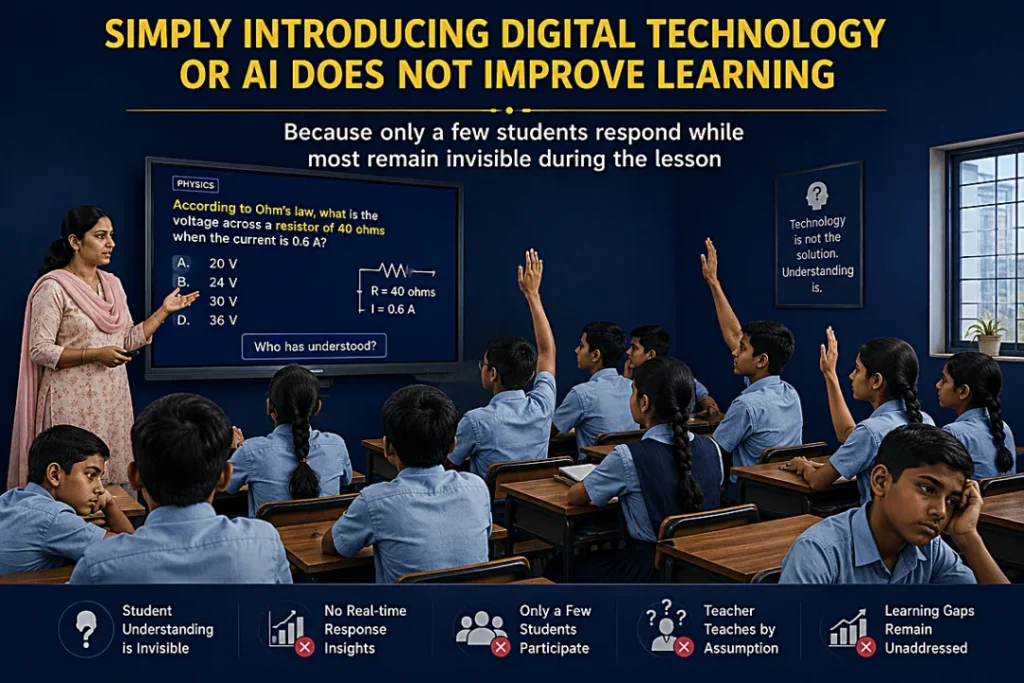
The problem in many smart classrooms, there is no or very limited interaction and hence learning is less visible.
When students learn through videos, self-paced content, or AI tools, the teacher often loses sight of what they actually understand.
A few students may answer. A few may ask questions. But the understanding of the full class remains unclear.
And when teachers do not see learning clearly, they cannot correct learning effectively.
By the time the gap appears in homework or an exam, the moment to fix it has often passed.
Why Real-Time Response with Instant Statistical Results Matters
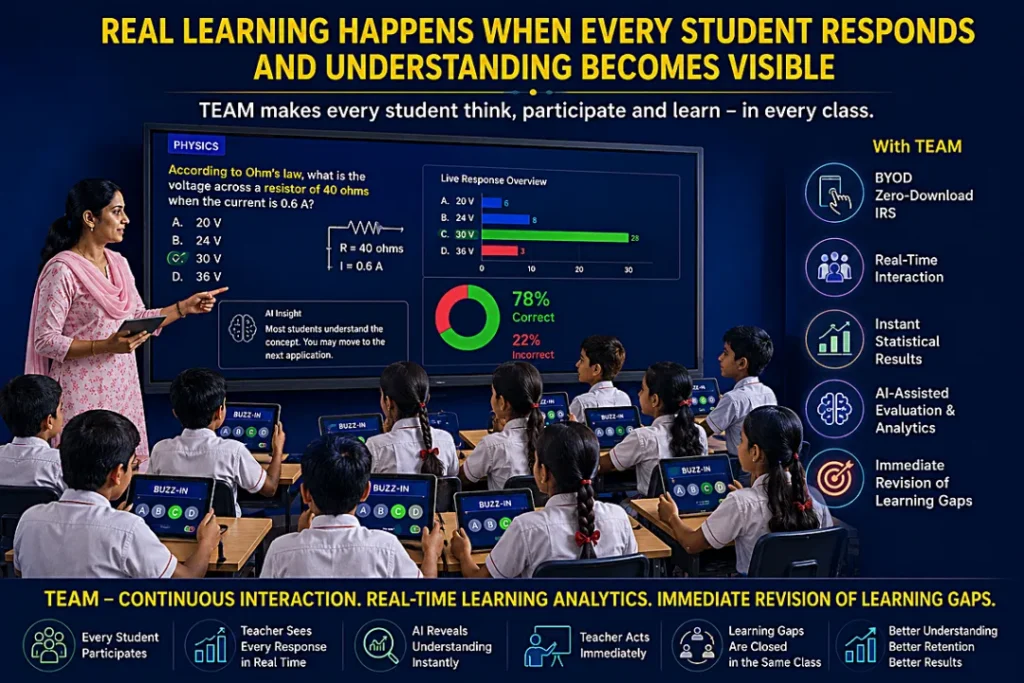
If learning is to improve, teachers need visibility into all students’ responses within the same class session, not just the answers of a few students who usually speak up. That is where real-time response becomes transformative, especially when every response is supported by instant statistical results that reveal the actual learning status of the whole class.
When every student responds during the lesson, teachers do not have to guess whether the class has understood. They can immediately view bar charts, pie charts, correct-response patterns, and other response trends that make learning visible at that exact moment. This shifts the classroom from assumption-based teaching to evidence-based teaching.
Instant statistical analysis also improves the quality of classroom intervention. Instead of waiting for homework, weekly tests, or term-end exams, teachers can identify misconceptions, spot learning gaps, and decide what needs to be re-explained within the same class session. They can also decide which students or groups need immediate support and which learners are ready to move forward
This is what makes real-time response more than just interaction. It connects response, statistical analysis, and teacher action in one continuous teaching-learning cycle, which is what, should now be called meaningful EdTech.
Why Immediate Revision Changes Learning
Learning improves when feedback is immediate.
When a misconception is corrected only after homework or a test, it has already had time to settle. Students may repeat the wrong idea, build on it, or lose confidence. But when the correction happens in the same class session, the learning becomes stronger and more durable.
Immediate revision allows teachers to re-explain, reframe, and reinforce concepts while the lesson is still fresh. Students get a second chance to understand before moving on.
This is how competency grows.
Not by covering more content, but by ensuring the content has actually been understood.
AI Alone Is Not the Answer
Much of the current excitement around AI in education is built on the assumption that AI itself will improve outcomes. But AI alone mostly improves speed and convenience.
It can generate content, produce summaries, create quizzes, and even answer student questions. What it cannot do by itself is guarantee that every student has truly understood the lesson.
That is the difference between using AI as a standalone tool and using AI as part of an integrated learning system.
A standalone AI tool may help students complete work faster. An integrated AI-powered EdTech system will help teachers make learning visible, measurable, and actionable. That distinction matters.
The goal should never be to replace teaching with automation. The goal should be to strengthen teaching with intelligence.
What Schools Should Actually Invest In
Schools do not need more technology for the sake of technology.
They need systems that improve learning outcomes.
That means investing in solutions that:
- Help teachers evaluate all students within the same class session.
- Make student understanding visible in real time.
- Support immediate correction and revision.
- Enable evidence-based teaching decisions.
- Encourage active participation from every learner.
The best technology in education is not the one that looks most advanced.
It is the one that helps teachers teach better and helps students learn better.
TEAM – AI powered EdTech solution for K-12 Schools
This is where TEAM becomes highly relevant for K-12 schools in the AI era.
TEAM is an AI-powered EdTech solution designed to support classroom learning in a structured and teacher-led way. It enables teachers to evaluate all students’ responses within the same class session, making learning visible while the lesson is still in progress.
TEAM is built around purpose-designed AI tools that connect lesson delivery, student participation, assessment, and teacher decision-making into one integrated classroom system.
- TEAM AI Flow: Unlike general LLMs, it does not require teachers to copy, cut, and paste student responses into a separate AI tool for rating and comments. It automatically connects live student responses to generative AI and sends the AI’s ratings and comments directly into the teacher’s score sheet.
- AI Automated Grading and Prompt Embedding: Teachers can embed grading prompts into digital assignments, presentations, quizzes, and syllabus materials. The AI then evaluates subjective and handwritten responses instantly, while the teacher remains the final authority.
- Generative Content Creation: Teachers can quickly generate questions, instruction sets, and AI-based mind maps from lesson content, making preparation faster and more focused.
- Advanced Text and Data Analytics: AI can process large volumes of student text responses and convert them into visual insights such as smart categories, keyword frequency charts, and word clouds.
- AI Speech Recognition and Voice Interaction: Students can practice speaking, receive automatic pronunciation and fluency scoring, and generate searchable voice-to-text records of classroom interaction.
TEAM also extends learning after the classroom through the cloud-based AClass ONE student companion module. This gives students a way to revisit teacher notes, practice concepts, and continue targeted learning beyond class, creating a connected cycle of instruction, assessment, and reinforcement.
For schools, this means AI is not used as a shortcut. It is used as a learning partner that supports teaching, feedback, and improvement.
Conclusion
Digital technology and AI have not failed education. They have fallen short because they have often been used in ways that prioritize access over understanding, convenience over interaction, and speed over mastery.
Real learning is not created by devices alone. It is created when students think deeply, respond actively, and receive timely feedback while the lesson is still happening.
That is why the future of education will not be shaped by how much technology classrooms have.
It will be shaped by how well that technology helps teachers make learning visible, measurable, and actionable.
And that is exactly the shift education needs now.