
How Schools Can Continue to Measure Authentic Learning in the Age of AI
Educational institutions are under growing pressure to deliver measurable learning outcomes, maintain academic quality, and ensure that assessment truly reflects student understanding. At the same time, the rapid and often unsupervised use of Artificial Intelligence by students for homework, assignments, and take-home work has made many conventional evaluation methods less reliable as indicators of actual learning.
Artificial Intelligence is rapidly transforming education. AI can generate lesson plans, create assessments, summarize content, provide tutoring support, translate learning materials, and reduce repetitive administrative tasks. For teachers and institutions, these capabilities offer significant opportunities to improve efficiency and enhance learning experiences.
However, the rapid adoption of AI has also introduced new challenges. When students increasingly rely on AI-generated answers, institutions face growing concerns regarding academic integrity, critical thinking, problem-solving ability, and the long-term development of cognitive skills. The challenge is no longer whether students have access to AI, but whether educational systems can continue to measure authentic understanding in a credible and meaningful way.
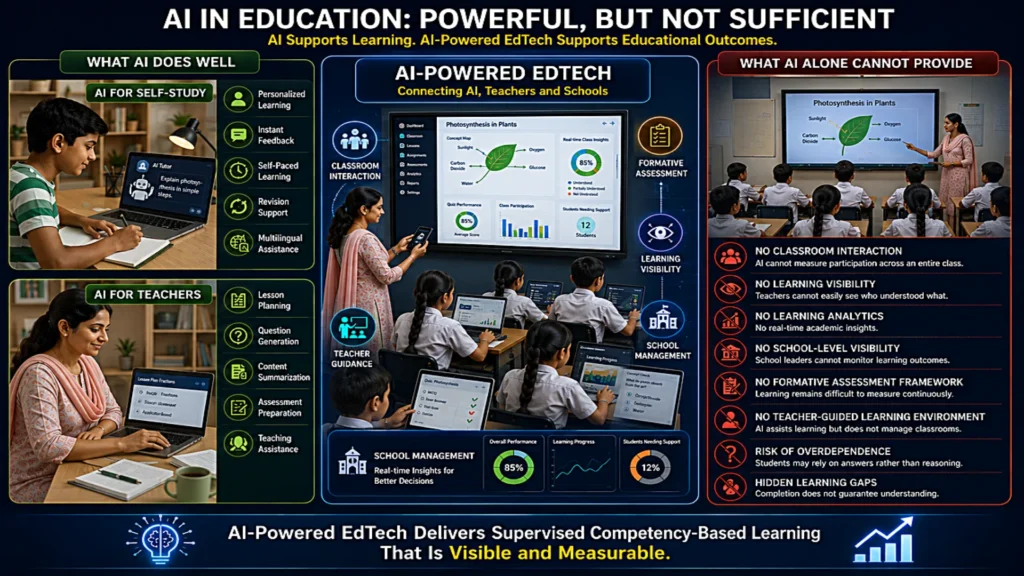
This is why AI-Powered EdTech has become important not merely as a digital upgrade, but as a strategic academic framework for educational institutions. Its real value lies in strengthening supervised learning, enabling data-driven teaching, reducing administrative burden, and supporting Competency-Based Learning rather than leaving institutions dependent on homework, Rote Learning, and delayed Summative Assessment.
What Is AI-Powered EdTech?
AI-Powered EdTech combines the intelligence of Artificial Intelligence with the interconnected hardware, software, and network platforms that form the foundation of EdTech.
Traditional EdTech digitized education through online content, Learning Management Systems, virtual classrooms, digital assessments, and blended learning environments. Artificial Intelligence adds a new layer of intelligence by supporting personalized learning, automated assessment, learning analytics, content generation, and academic decision-making.
The true value of AI-Powered EdTech lies not in replacing teachers or automating education, but in creating structured learning environments where technology supports better teaching, more meaningful assessment, and improved educational outcomes.
For educational institutions, AI-Powered EdTech represents the evolution from simply delivering content to continuously measuring, understanding, and improving learning.
The Institutional Challenge
For many institutions, the central concern today is not whether students have access to AI, but whether academic systems can still measure authentic understanding in a credible way.
When homework and assignments are completed with unrestricted AI support, they cease to function as dependable indicators of comprehension, making it harder for institutions to monitor standards, compare performance, and maintain academic integrity.
Traditional assessment models often rely heavily on after-class tasks, periodic tests, and delayed evaluation. In practice, these push institutions toward memory-based measurement and Rote Learning rather than real comprehension, while also limiting the institution’s ability to identify learning gaps early enough for timely academic intervention.
The challenge is not preventing students from accessing AI.
The challenge is designing learning environments where understanding can be measured while learning is taking place.
This is where AI-Powered EdTech fundamentally differs from traditional educational approaches. Instead of relying heavily on homework, delayed testing, and retrospective evaluation, AI-Powered EdTech enables institutions to measure learning continuously, identify gaps early, and support timely intervention while the learning process is still underway.
Moving Assessment into Synchronous Learning
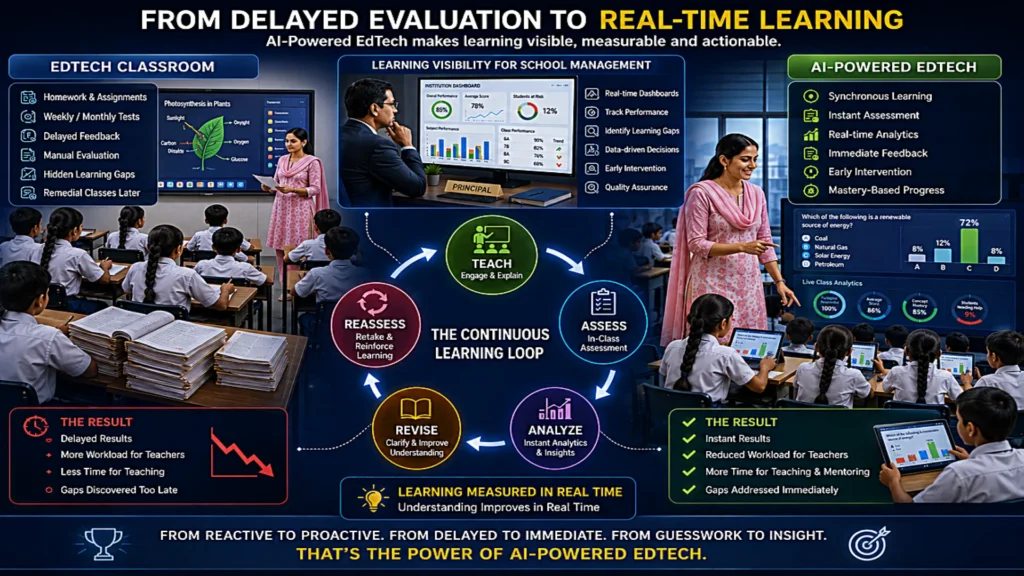
AI-Powered EdTech offers a stronger alternative by shifting assessment into the live classroom through Synchronous Learning.
In this model, teachers can conduct in-class tests, collect student responses immediately, auto-grade them, and generate statistical insights during the same session rather than waiting for homework review or weekly test cycles.
This turns assessment into an active academic process instead of a delayed administrative exercise. It also allows institutions to treat classroom evaluation as a form of continuous Formative Assessment, where student understanding is measured while learning is still taking place, rather than relying only on end-stage Summative Assessment after misunderstandings have already accumulated.
From Instant Analytics to Immediate Teaching Action
The real strength of this approach lies in what happens after the responses are collected.
Once the system produces instant statistical reports, teachers can immediately identify which concepts were understood, which questions caused difficulty, and which parts of the lesson need clarification for the class as a whole.
This allows teaching to become responsive within the same session.
Instead of moving ahead with the syllabus and discovering gaps later, the teacher can revise the topic on the spot, offer additional explanations, and conduct a retake assessment in the same class, creating a closed loop of:
Teach → Assess → Analyze → Revise → Reassess
For institutes, this has major academic value. It reduces the need for remedial special class later, improves classroom effectiveness, and creates a more transparent record of learning progress across subjects, batches, and departments.
Real-Time Classroom Interaction: A Natural Guardrail
One of the growing concerns in education is the increasing use of AI-generated text responses for home work, assignments, and projects.
However, classroom learning is fundamentally different when AI powered Ed tech solution is deployed.
When students respond immediately during live classroom interactions, they must think independently, organize their thoughts, express ideas in their own words, and demonstrate understanding in real time.
This shifts learning from answer generation to genuine participation.
Modern AI-Powered EdTech environments enable every student in a classroom to respond simultaneously using text, images, videos and even spoken responses.
Spoken responses are particularly valuable because they reveal not only what students know but also how they think, explain, reason, and communicate.
While students can easily use AI to generate text-based answers, participating in real-time spoken classroom interactions remains significantly more difficult to automate. For the foreseeable future, real-time classroom voice interaction provides a natural safeguard against overdependence on AI-generated responses while encouraging authentic participation.
The most effective guardrail against AI misuse may not be technology restrictions.
It may be classroom designs that require students to actively think, speak, explain, justify, and participate.
Supporting Competency-Based Learning Beyond the Classroom
Even in a strong Synchronous Learning environment, not every student learns at the same pace.
That is why the integration of a proper Learning Management System with teacher-uploaded session-wise electronic notes becomes essential.
After class, students can log in, review the exact lesson taught, revisit concepts they did not fully understand, and study those concepts repeatedly at their own pace.
This combination of supervised in-class assessment and self-paced post-class revision supports Competency-Based Learning in a practical way.
Instead of progressing merely because the timetable moves forward, students can continue reviewing content until they achieve clarity and mastery, leading to stronger retention and more meaningful academic progress.
Reducing Dependence on Rote Learning and Delayed Testing
One of the most important academic shifts enabled by AI-Powered EdTech is the reduced dependence on routine homework, weekly tests, and memory-driven evaluation.
When understanding can be measured during the class itself, institutes no longer need to rely so heavily on take-home tasks that may reflect AI assistance more than student ability.
This also creates an opportunity to reduce overemphasis on Rote Learning.
Instead of rewarding students mainly for recalling content in delayed tests, institutes can build a stronger balance between Formative Assessment during live sessions and purposeful Summative Assessment when broader evaluation is required.
Lower Workload for Teachers, Stronger Systems for Institutes
AI-Powered EdTech is also valuable because it reduces repetitive academic workload for teachers.
Manual question paper preparation, answer paper correction, score tabulation, and repetitive reporting consume substantial faculty time, often leaving less room for actual teaching, mentoring, and concept reinforcement.
When these functions are automated through in-class testing, auto-grading, and instant reporting, teachers can focus more on instruction and less on clerical work.
For institutes, this does not simply improve efficiency; it strengthens academic delivery by allowing faculty energy to be directed toward learning quality rather than administrative repetition.
Value for Institutes, Teachers, and Students
The primary value of AI-Powered EdTech lies at the institutional level.
For School Management, AI-Powered EdTech provides continuous visibility into learning outcomes. Instead of waiting for periodic examinations and academic reviews, institutional leaders gain access to real-time academic indicators that support evidence-based decision-making, quality assurance, accreditation readiness, curriculum improvement, and early identification of learning challenges across classes, grades, and departments.
Teachers benefit through instant analytics, reduced correction workload, better classroom control, and the ability to act on evidence immediately during Synchronous Learning sessions. More importantly leading better quality of life
Students benefit through supervised assessment, timely clarification, Learning Management System-based revision, self-paced reinforcement, and a clearer path toward mastery rather than superficial completion of tasks.
Parents benefit through improved visibility into student progress and learning outcomes.
Enabling Blended Teaching Models
Depending on how the academic system is deployed, the same approach also support Blended Learning.
Institutes can combine classroom teaching, digital assessments, Learning Management System-based revision, and hybrid delivery models without losing continuity in academic monitoring and learner support.
This flexibility is particularly valuable when institutions must respond to changing external environments like weather, pandemic etc., while maintaining consistency in assessment and learning quality.
EdTech vs AI vs AI-Powered EdTech
Aspect EdTech AI AI-Powered EdTech
Primary Focus Digital Access Intelligence Educational Outcomes
Teacher Role Facilitator Often Reduced Central and Guided
Personalization Limited High Guided and Personalized
Learning Visibility Limited Partial High
Decision Making Manual Automated Human + AI
Assessment Periodic Automated Continuous and Actionable
Student Engagement Moderate Variable High and Supervised
Conclusion
AI-Powered EdTech is the go to solution because it helps institutes restore confidence in how learning is measured and improved.
In an environment where unsupervised AI use can weaken the reliability of homework and assignments, the smarter response is not to resist technology, but to use it to strengthen Synchronous Learning, support Formative Assessment, reduce dependence on Rote Learning, and advance Competency-Based Learning in a structured and measurable way.
The future of education is unlikely to be defined by Artificial Intelligence alone. Nor will it be determined solely by digital learning platforms.
The institutions that succeed will be those that combine Educational Technology and Artificial Intelligence within structured academic frameworks that preserve critical thinking, strengthen teacher guidance, and make learning visible in real time.
For institutes, this is not just a technology shift.
It is an academic redesign that improves governance, supports teachers, strengthens student learning, and moves education from delayed evaluation toward genuine knowledge acquisition.